The Sunday Potthesundaypot.com/recipes/fesenjan/
Fesenjan: Persian Chicken Stew with Walnuts and Pomegranate
By The Sunday Pot Kitchen Updated
- • About 2 hours 50 minutes in one Dutch oven: 1 hour for the walnuts alone, 15 minutes with the molasses, 45 with the chicken
- • 3 cups (300 g) of toasted walnuts, ground fine but not to butter, and ¾ cup (180 ml) of pomegranate molasses
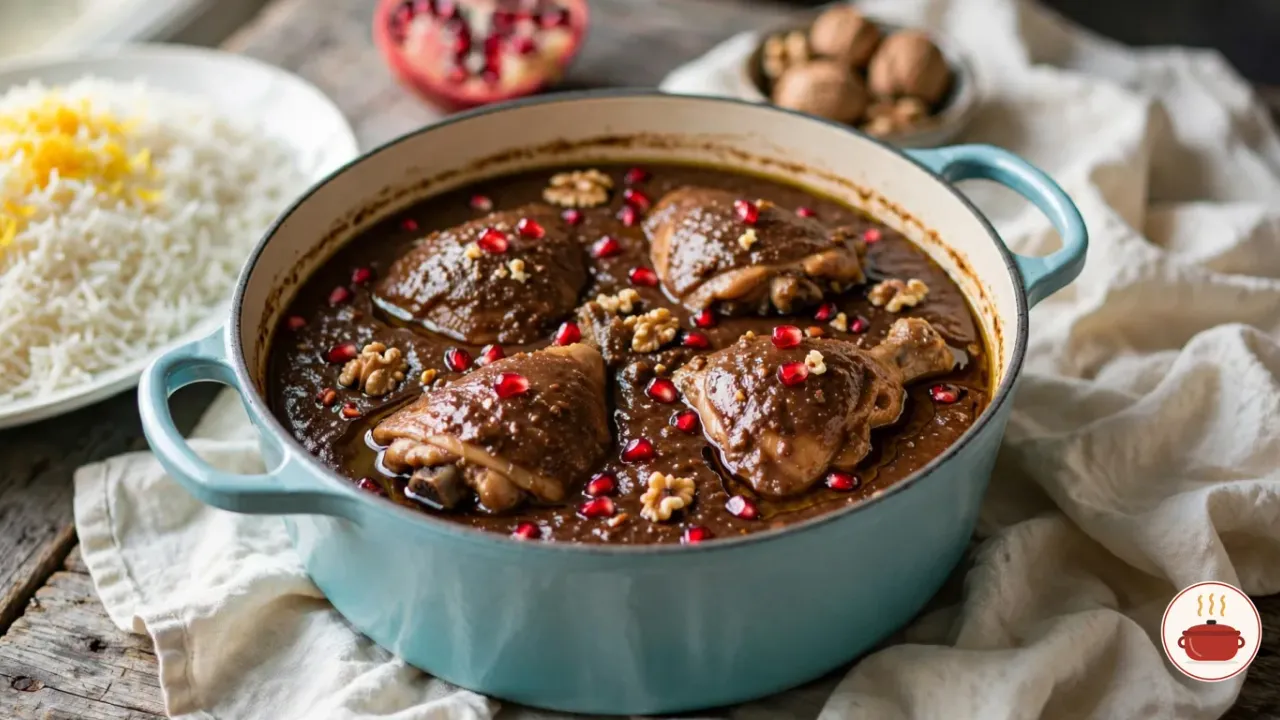
- • The sauce is ready when it is deep chocolate brown and walnut oil pools on top
- • Stir every 10 minutes, scraping the bottom, so the walnuts never catch
- • Taste at the end: sugar for a sour sauce, molasses for a sweet one
- • It tastes even better the next day; chill leftovers within 2 hours and eat them within 3 to 4 days
Ingredients
6 servingsInstructions
Fesenjan is the Persian stew of chicken in a dark sauce of ground walnuts and pomegranate molasses. It tastes sweet, sour and nutty all at once. In this version, the walnuts simmer for 1 hour in one Dutch oven. Then the molasses goes in, and the chicken braises for 45 minutes. It serves 6 over rice.
What fesenjan is
Fesenjan is a khoresh, the Persian word for a stew that is spooned over rice. It is made with walnuts, poultry and pomegranate, explains the Encyclopaedia Iranica. The same entry says that almonds or small meatballs can stand in, and that duck was the usual bird. Two Persian dictionaries spell it fesenjun, which is why you will also see fesenjoon in English.
The pomegranate gives the sauce its dark brown color, Iranica notes. As it cooks, the sauce turns a deep shade close to mole poblano. Samin Nosrat makes that comparison in her recipe for NYT Cooking.
A stew from Gilan
Fesenjan comes from Gilan, the green province on the Caspian Sea. The oldest dictionary that names the dish says so, and adds that the people of Gilan know how to cook it well. Nosrat describes northern hills and coast where pomegranate and walnut trees grow.
The first written recipe is younger than you might think. A cookbook by the chef to Naser al-Din Shah, who ruled from 1848 to 1896, lists ten kinds of fesenjan. They run from walnut and almond to quince, pumpkin, fish and yogurt. You may read that the dish goes back to ancient Persia. Iranica’s oldest record is that 19th-century court cookbook.
Duck, chicken or meatballs
Fesenjan was first a duck dish, and Gilan is known for its ducks as well as its walnuts and pomegranates. Chicken took over because duck is harder to find, says Shadi HasanzadeNemati of Unicorns in the Kitchen. In Gilan, a family may cook it with teal or wild duck on special days, according to a second Iranica entry on Gilan’s cooking. The cookbook writer Najmieh Batmanglij cooks the Gilaki version as slow-cooked duck, served over smoked rice.
Sweet, sour or both
Every family balances the sauce its own way. In Gilan, cooks make it darker and more sour, with paste from wild pomegranates. They never add sugar, Iranica’s entry on Gilan says. Elsewhere, cooks add sugar and fried onions when the pomegranate is too sharp.
Kiana Jalali grew up in Esfahan. Some regions like it sweet, some sour and some both, she told RNZ. This recipe aims for the middle, and lets you finish it to your taste.
A dish for guests and long nights
Fesenjan is an elaborate dish, kept for festive days. Iranians count it as a rich man’s dish. An old saying mocks a show-off as someone who acts as if he has eaten partridge and fesenjan.
It is also a highlight of Shab-e Yalda, the winter solstice night, NYT Cooking notes in a fesenjan recipe by Azita Houshiar. UNESCO added Yalda to its intangible heritage list in 2022. On that night, families in Iran and Afghanistan set the table with red fruits such as pomegranates, along with nuts. In 2026, Yalda falls on the evening of 21 December.
Why fesenjan is worth making now
Middle Eastern food keeps growing. In its trends for 2027, published on 30 September 2026, the UK food distributor Bidfood named Middle Eastern cuisine among the flavors to watch. Middle Eastern menu items in the UK grew by over 15% in a year, by Tastewise data from May 2026. Bidfood also reports 22% of consumers keen to try Middle Eastern and Levantine food. Its Middle Eastern trend notes name dishes such as shawarma, hummus and mujadara, not Persian ones. Nobody publishes a figure for fesenjan itself.
Persian cooking has its own signs. In May 2026, the New York Times named two Iranian restaurants, Sofreh and Eyval, among the 100 best in New York City, as Secret NYC reported. “Persian cuisine is definitely having a moment,” the chef Sayat Ozyilmaz told Fine Dining Lovers in September 2025. That article followed tahdig, the crisp Persian rice, onto restaurant menus across the US.
Pomegranate is a popular flavor too. In July 2026, BeverageDaily reported on the US flavor house Imbibe’s forecast for 2027. Imbibe lists pomegranate among the deep red fruits that run through US drinks.
The season helps as well. Mehregan, an autumn harvest festival in Iran and Tajikistan, runs from 2 October to 2 November each year. Communities set a table of pomegranates and other fruit, and serve nuts, as UNESCO describes. It joined UNESCO’s list in 2024.
What you need for fesenjan
Walnuts
Walnuts make the sauce, so buy 3 cups (300 g) of fresh, unsalted ones. Stale walnuts taste bitter and can ruin the stew, warns Laura Bashar of Family Spice. Taste one before you start.
Recipes use from 8 oz (225 g) to 1 lb (450 g) of walnuts. Nosrat uses 1 lb, and Prewer 3½ cups. This pot sits in the middle.
Pomegranate molasses
Pomegranate molasses is pomegranate juice boiled down to a thick, tart syrup. Look for it in Middle Eastern shops and large supermarkets. Brands differ a lot. Some hold only pomegranate concentrate and sugar, and others list water, sugar, date juice and citric acid. Read the label, and start with ¾ cup (180 ml).
Chicken
Use bone-in chicken thighs with the skin removed, as Nosrat does, and as Mersedeh Prewer does at The Mediterranean Dish. Thighs stay juicy through 45 minutes of braising. You need 2½ lb (1.1 kg), about 8 thighs.
Onion, turmeric and cinnamon
One large onion, cooked until golden, sweetens the sauce. Turmeric seasons the chicken, and ½ teaspoon of cinnamon warms the walnuts. Saffron is optional. Prewer and Bashar both bloom it in a spoonful of water first.
A heavy pot
A 5½- to 7-quart (5.2 to 6.6 liter) enameled Dutch oven holds the whole stew. A thick base matters, because walnut sauce catches easily. An old cook from the Caspian taught Ariana Bundy to leave a wooden spoon in the pot, so the stew would not stick.
How to make fesenjan in one Dutch oven
Toast, then grind fine
Toast the walnuts at 350°F (175°C) for 8 to 12 minutes, until golden inside. Nosrat toasts hers for about 12 minutes. Let them cool, then grind them as finely as you can without making a paste. Prewer stops when the walnuts look like sand that clumps together.
Simmer the walnuts until the oil rises
This is the long step, and it builds the flavor. Simmer the ground walnuts in 4 cups (950 ml) of water for 1 hour, partly covered. Most Persian recipes give it 1 to 2 hours. The sauce is ready when the walnuts release their oil and a glossy layer forms on top, Jalali explains.
Darken it with pomegranate
Stir in the molasses and 1 tablespoon of sugar, then simmer for 15 minutes. The sauce turns from tan to deep chocolate brown. It keeps darkening as the chicken cooks.
Braise the chicken for 45 minutes
Return the browned chicken and simmer for 45 minutes, until the meat pulls from the bone. The USDA sets 165°F (73.9°C) as the safe temperature for chicken thighs. A gentle 45-minute simmer takes them well past it.
Taste for sweet and sour
Fesenjan should taste sweet and sour together. Nosrat adds up to 2 teaspoons of sugar when the sauce is too tart. If it is too sweet, add more molasses, or a squeeze of lemon as Bundy does. Add salt last, a pinch at a time.
Variations: duck, meatballs, squash or eggplant
Duck fesenjan
For the old Gilan version, use 4 duck legs. Brown them well and pour off most of the fat. Braise them for 1½ to 2 hours, until tender.
Meatballs
Some families make fesenjan with small meatballs, HasanzadeNemati writes. Roll 1 lb (450 g) of ground beef or lamb into 1-inch (2.5 cm) balls. Sear them, then add them for the last 10 to 15 minutes.
Squash, pumpkin or eggplant
Cooks in parts of Iran add peeled pumpkin, both for balance and in place of sugar, Iranica notes. Add 2 cups (about 300 g) of diced butternut squash with the molasses. For a vegetarian stew, skip the chicken and simmer roasted eggplant or squash in the sauce for 20 minutes.
Serving and storing fesenjan
Serve fesenjan over steamed basmati rice, with pomegranate seeds on top. For a feast, make Persian rice with a crisp crust, as in Nosrat’s polo ba tahdig. Plain yogurt and a sharp salad cut the richness. For a smaller saffron rice, borrow the method from our chicken biryani.
If you like nut-thickened sauces, ají de gallina from Peru folds walnuts or pecans into a creamy chicken stew. For a Middle Eastern side, mujadara is lentils and rice under fried onions.
Make it a day ahead
Iranians say their stews taste better the day after, Prewer writes, because the flavors get to know each other. Cook the fesenjan, chill it, and reheat it gently the next day.
Leftovers
Follow the USDA’s advice on leftovers:
- Refrigerate the stew within 2 hours of cooking, in shallow containers.
- Eat it within 3 to 4 days, or freeze it for 3 to 4 months.
- Bring the sauce to a rolling boil when you reheat it, and stir in a splash of water.
Calories and nutrition per serving
One serving, a sixth of the pot, has about 680 calories, 37 g of protein and 39 g of carbohydrate, by USDA figures. It has about 43 g of fat, most of it from the walnuts. Only about 5 g of that is saturated. Walnuts are rich in ALA, a plant omega-3. USDA lists 9 g of it per 100 g of English walnuts, so each serving holds about 4.5 g. One serving also has about 730 mg of sodium, before any salt you add at the table.
Allergens
Fesenjan is built on walnuts, a tree nut. Tree nuts are among the major food allergens the FDA lists. There is no nut-free fesenjan. Bashar suggests pecans for a walnut allergy, but pecans are tree nuts too.
Fixes for thin, pale, bitter or oily fesenjan
- Thin sauce: simmer it uncovered for 10 to 15 minutes more.
- Pale sauce: it needs more time. Keep simmering, or add 2 tablespoons (30 ml) more molasses.
- Too sour: stir in sugar, 1 teaspoon at a time.
- Too sweet: add 1 to 2 tablespoons (15 to 30 ml) of molasses or a squeeze of lemon.
- Bitter: the walnuts were stale or over-toasted. A little sugar helps, but use fresh nuts next time.
- Stuck to the pot: stir in ¼ cup (60 ml) of water and lower the heat.
- Too oily: skim some walnut oil off the top with a spoon, as Nosrat does.
Substitutes for missing ingredients
- Pomegranate molasses: simmer 4 cups (950 ml) of pomegranate juice for 45 to 55 minutes, until about ¾ cup (180 ml) is left. America’s Test Kitchen adds 2 tablespoons of brown sugar.
- Chicken thighs: duck legs, chicken drumsticks, or boneless thighs simmered for 25 minutes.
- Some of the walnuts: blanched almonds, up to a third of the total, as HasanzadeNemati suggests.
- Saffron: leave it out. The stew is still complete.
- Fresh pomegranate seeds: chopped toasted walnuts, or fresh parsley.
- Dutch oven: any heavy pot with a lid.
Frequently asked questions
What does fesenjan taste like?
It tastes rich, nutty, sweet and sour at once. The walnuts give it body, and the pomegranate molasses gives it a tangy, fruity depth.
Is it fesenjan or fesenjoon?
Both are right. Fesenjan is the usual spelling, and fesenjoon follows the Persian dictionaries that spell it fesenjun.
Why is my fesenjan not dark?
It needs more time. The sauce darkens slowly as the walnuts release their oil and the pomegranate cooks. Simmer it for 15 to 30 minutes more.
Should I skim the oil off fesenjan?
You can. The oil shows the walnuts have cooked enough. Nosrat skims some away before serving, but many cooks leave it.
Can I use pomegranate juice instead of molasses?
Yes. Boil down 4 cups (950 ml) of juice to about ¾ cup (180 ml), or use the juice as part of the liquid, as Nosrat does.
Can I make fesenjan ahead?
Yes. It tastes even better the next day. Chill it within 2 hours, then reheat it gently with a splash of water.
How long does fesenjan keep?
Up to 3 to 4 days in the refrigerator, or 3 to 4 months in the freezer, as the USDA advises for leftovers.
What do you serve with fesenjan?
Steamed basmati rice, ideally with a crisp tahdig, plus yogurt and a fresh herb or cucumber salad.
Can fesenjan be made without nuts?
No. Walnuts are the heart of the sauce. Almonds can replace some of them, but almonds are tree nuts too.
Tags: Sunday dinnerchickenwalnutspomegranateDutch ovenone potstew