The Sunday Potthesundaypot.com/recipes/chicken-biryani/
Chicken Biryani in a Dutch Oven with Saffron and Mint
By The Sunday Pot Kitchen Updated
- • About 2½ hours in all: a 1-hour marinade while the onions fry and the rice soaks, then 75 minutes of cooking and resting
- • 2½ lb (1.1 kg) of bone-in chicken and 2½ cups (500 g) of basmati rice feed 6
- • Boil the rice for only 5 to 6 minutes, until about 70% cooked: the steam in the pot finishes it
- • Seal the pot with foil and the lid, then bake it at 325°F (165°C) for 30 minutes
- • The chicken is done at 165°F (74°C) in the thickest piece
Ingredients
6 servingsInstructions
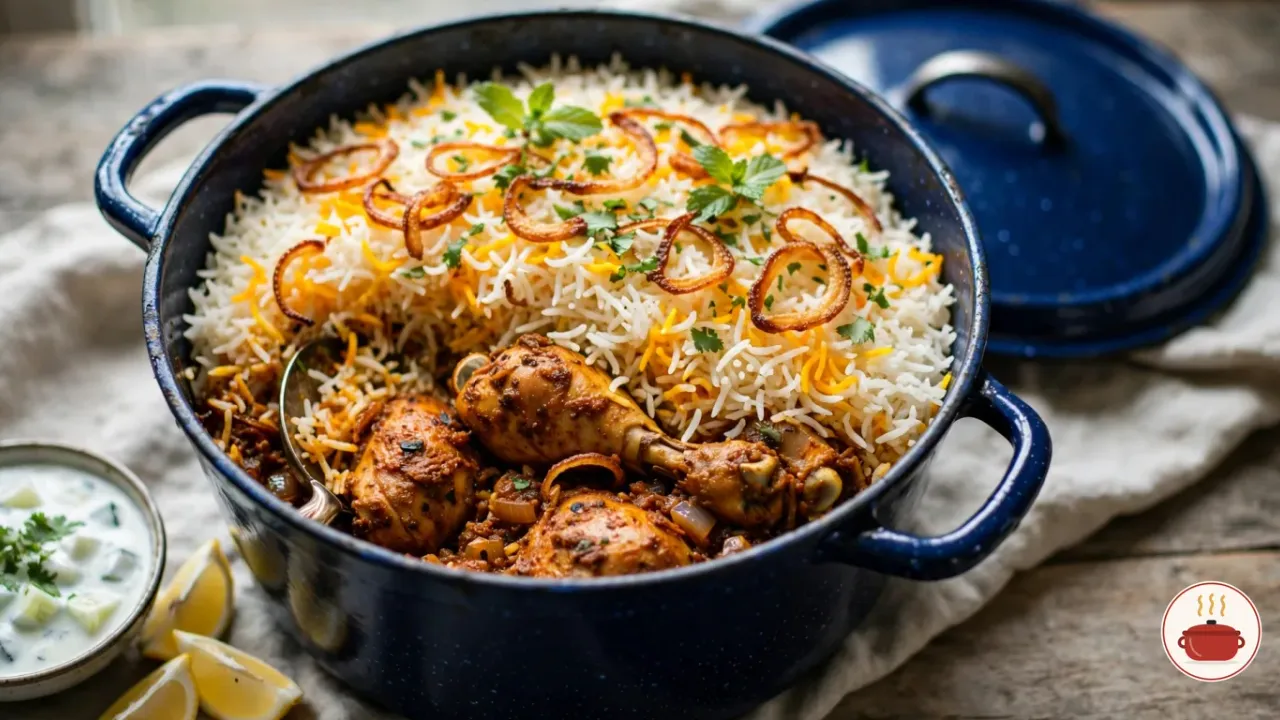
Chicken biryani is a layered rice dish from India: spiced, yogurt-marinated chicken under long grains of basmati, fried onions, mint and saffron. This version bakes in one Dutch oven. You marinate the chicken for 1 hour and cook it in its sauce. Then top it with half-cooked rice, seal the pot and steam it at 325°F (165°C) for 30 minutes.
What chicken biryani is
Biryani is rice and meat cooked in layers under a tight lid. The rice finishes in the steam that rises from the spiced meat below it. When you serve it, each spoonful holds plain white grains, saffron-gold grains and grains stained red by the sauce.
Its history is a lively argument. Google Arts & Culture tells the best-known legend: royal Mughal cooks made one dish of rice and meat to feed hungry soldiers. The same story notes an older theory, of similar dishes in Tamil Nadu around 2 AD. It credits the kingdoms of Awadh and Hyderabad with perfecting the method.
Nearly every region now has its own style. Hyderabadi biryani is bold and spicy. Lucknowi biryani is milder and fragrant, and Kolkata biryani adds potatoes. Hyderabad, which UNESCO named a Creative City of Gastronomy in 2019, is the city many people link with the dish.
It is also having a moment in the US. Yelp’s 2026 trend report found searches for “biryani chicken” up 49% in the 12 months to August 2025, compared with the year before.
Kacchi and pakki biryani
Cooks sort biryani into two methods. In kacchi biryani, raw marinated meat goes under the rice, and both cook together in the sealed pot. In pakki biryani, the meat cooks first, and the rice finishes on top of it.
This recipe uses the pakki method. The chicken simmers in its sauce before the rice goes on, so you can taste it and fix the seasoning. The timing is far more forgiving in a home oven.
What you need: rice, spices and a heavy pot
Buy aged basmati rice if you can find it. Its long, slender grains stay separate and grow longer as they cook. Rinse it 3 or 4 times, until the water runs almost clear, then soak it for 30 minutes. Rinsing washes off loose starch, and soaking helps the grains cook evenly without breaking.
The spices come in two sets. Whole spices go into the rice water: green cardamom, cloves, a cinnamon stick and bay leaves. Ground spices go into the marinade: garam masala, turmeric and Kashmiri chili powder. Kashmiri chili gives a deep red color with gentle heat.
Use a heavy 6- to 7-quart (5.7 to 6.6 liter) Dutch oven with a tight lid. The thick base spreads the heat, so the chicken on the bottom browns a little but does not burn. Traditional cooks seal the lid with a rope of dough. A sheet of foil under the lid does the same job.
Fried onions: the flavor base
Fried onions give biryani much of its deep, sweet flavor. You need 3 large onions, about 2 lb (900 g), sliced thin, about ⅛ inch (3 mm) thick. They look like a mountain, but they shrink to about 2 cups.
Fry them in ½ cup (120 ml) of oil in the Dutch oven. Start over medium-high heat for 5 minutes, then lower the heat to medium for 15 to 20 minutes more. Stir more often as they darken. Pull them out when they are deep golden brown, since they keep darkening for a minute after they leave the oil. Burnt onions taste bitter, so watch the last 5 minutes closely.
Half of the onions go into the chicken’s sauce, and half go on top of the rice. The oil left in the pot now tastes of onion. Keep 3 tablespoons (45 ml) of it to cook the chicken, and save the rest for frying eggs or vegetables the same day.
How to cook chicken biryani in a Dutch oven
Marinate the chicken first. The yogurt and lemon juice make the meat tender, and the spices reach the bone through a few deep slashes. One hour works, and overnight is better. The USDA says to marinate poultry in the refrigerator, never on the counter, and allows up to 2 days.
Next, cook the chicken in its marinade with half the fried onions. After about 25 minutes, the sauce should be thick enough to coat the meat, with little liquid in the pot. A thin, watery sauce would make the rice soggy.
The 70 percent rule for the rice
The rice finishes in the steam from the chicken. If it goes in fully cooked, it turns soft and sticky under the lid. So boil it in salty water for just 5 to 6 minutes, until it is about 70% cooked.
To test it, press a grain between your fingers. It should bend, then break into 2 or 3 pieces with a firm white core. Drain it at once, and spread it over the chicken in a loose layer. Pressing it down crushes the grains and blocks the steam.
Sealing the pot for dum
Dum means cooking in trapped steam. Lay a sheet of foil over the pot and press the lid on hard. Warm the pot on the stove for 5 minutes to build steam, then bake it at 325°F (165°C) for 30 minutes. Let it rest, still sealed, for 10 minutes more.
When the chicken is done
The USDA safe minimum for poultry is 165°F (74°C). Push an instant-read thermometer through the rice into the thickest thigh, close to the bone but not touching it. Thighs and drumsticks stay juicy well past that mark. If the chicken reads lower, cover the pot again and bake it for 10 minutes more.
Serving and storing
Serve chicken biryani straight from the pot. Slide a wide spoon down to the bottom and lift, so every plate gets both layers. Put cucumber raita, lemon wedges and a few sliced red onions on the table. A hard-boiled egg, halved, is a common and welcome extra.
Like a classic pot roast, biryani depends on a heavy pot, a tight lid and low, steady heat. It makes a generous Sunday centerpiece for 6. Finish the meal with something warm, such as sticky toffee pudding, or start it with a small bowl of golumpki soup.
Cooked rice needs more care than most leftovers. The UK Food Standards Agency explains that uncooked rice can hold spores of a bacterium, Bacillus cereus, and the spores can survive cooking. Its advice for leftover rice:
- Chill it as fast as you can, ideally within 1 hour. Divide it into small, shallow containers to help it cool.
- Keep it in the refrigerator for no more than 1 day.
- Reheat it only once, until it is steaming hot all the way through.
- To freeze it, get it into the freezer within 1 hour of cooking. Thaw it in the refrigerator, then reheat it until steaming hot.
Substitutes for missing ingredients
- Kashmiri chili powder: 1½ teaspoons sweet paprika plus ½ teaspoon cayenne.
- Saffron: leave it out, or stir ⅛ teaspoon ground turmeric into the warm milk for color. You lose the aroma but keep the gold streaks.
- Garam masala: mix 1 teaspoon ground cumin, 1 teaspoon ground coriander, ½ teaspoon ground cinnamon, ¼ teaspoon ground cloves and ¼ teaspoon ground cardamom.
- Bone-in chicken: 2 lb (900 g) boneless, skinless thighs, cut into large pieces. Simmer them for 15 minutes in all, not 25.
- Aged basmati: any basmati rice. Long-grain white rice works too, but its grains stay shorter and softer.
- Homemade fried onions: 2 cups of crisp fried onions from an Indian or Persian grocer. Skip the canned, flour-coated kind, which turns soggy.
- Ghee: unsalted butter, or 2 more tablespoons of the onion oil.
- Whole-milk yogurt: Greek yogurt thinned with 2 tablespoons (30 ml) of water.
- Serrano chiles: 1 jalapeño, or leave them out for a milder pot.
Frequently asked questions
What is the difference between biryani and pulao?
Pulao cooks rice with meat or vegetables in a measured amount of liquid, much like a pilaf. Biryani boils the rice apart, then layers it over a spiced meat sauce and steams the two together. Biryani usually has more spice and a richer sauce.
Why did my biryani turn out mushy?
The rice probably went in more than 70% cooked, or it was not rinsed and soaked first. Boil it for only 5 to 6 minutes, drain it at once, and spread it loosely over the chicken. A thin, watery sauce under the rice can also make it soggy.
Can I make chicken biryani ahead?
Marinate the chicken in the refrigerator for up to 24 hours, and fry the onions earlier in the day. Cook the biryani itself on the day you serve it. Cooked rice keeps for no more than 1 day in the refrigerator.
How do I know the chicken is cooked?
Check the thickest piece with an instant-read thermometer. The USDA’s safe minimum for chicken is 165°F (74°C). If it reads lower, cover the pot and bake it for 10 minutes more.
Can I use boneless chicken?
Yes. Use 2 lb (900 g) of boneless, skinless thighs, cut into large pieces. They cook faster, so simmer them in the sauce for about 15 minutes before you add the rice. Breast meat dries out in this recipe, so stick with thighs.
What do you serve with chicken biryani?
Cucumber raita is the classic partner, since its cool yogurt balances the spice. Sliced red onions with lemon, a green salad and halved hard-boiled eggs all suit it too.
How long do biryani leftovers keep?
The UK Food Standards Agency advises chilling cooked rice within 1 hour and keeping it in the refrigerator for no more than 1 day. Reheat it only once, until it is steaming hot all the way through.