The Sunday Potthesundaypot.com/recipes/vietnamese-egg-coffee/
Vietnamese Egg Coffee (Cà Phê Trứng), the Hanoi Classic
By The Sunday Pot Kitchen Updated
- • One cup takes 1 egg yolk, 1 tablespoon (19 g) of condensed milk, 1 teaspoon (4 g) of sugar and 2 tablespoons (14 g) of coffee
- • Whip the yolk for 2 to 3 minutes with a hand mixer, or about 5 minutes by hand, until it triples and holds a ribbon
- • The yolk stays raw: use a pasteurized egg, or heat the yolk mix to 160°F (71°C) over simmering water
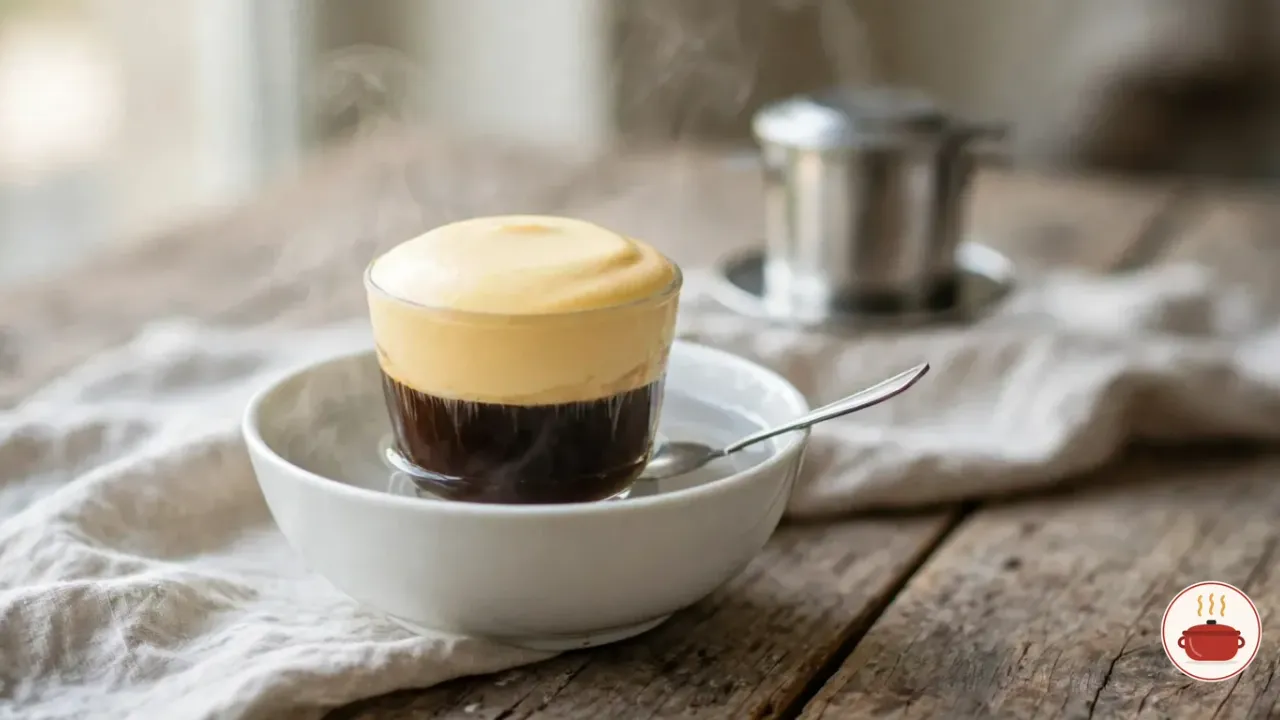
- • Stand the cup in a bowl of hot water, as Hanoi cafés do, so the coffee stays hot under the cream
- • About 135 calories a cup
Ingredients
1 servingInstructions
Egg coffee, or cà phê trứng, is a Hanoi specialty: strong black coffee under a thick layer of egg yolk whipped with sweetened condensed milk. It tastes like a warm, coffee-soaked tiramisu. One cup takes 1 egg yolk, 1 tablespoon of condensed milk and about 15 minutes. The cup stands in a bowl of hot water to stay warm.
What egg coffee is
Vietnamese egg coffee is two drinks in one cup. At the bottom sits hot, dark phin coffee, strong and bitter. On top floats a dome of egg yolk whipped with condensed milk and sugar. The cream is thick enough to eat with a spoon, and it tastes of custard, caramel and vanilla.
It does not taste of egg. The sugar and the coffee cover it, much as they do in a tiramisu. You eat a few spoonfuls of cream first, then stir the rest into the coffee, which turns it rich, sweet and velvety.
In Hanoi, the cup often arrives in a small bowl of hot water. The water keeps the coffee hot under the cold cream, because the drink cools fast in its small cup.
Where egg coffee comes from
Egg coffee was born of a shortage. CNN Travel tells the story: Nguyễn Văn Giảng was a bartender at the Sofitel Legend Metropole Hotel in Hanoi in 1946. Fresh milk was scarce, so he whisked egg yolk into coffee in its place.
Accounts of the date differ a little. VICE places it shortly after 1946, during the war with France, and others simply say the 1940s. Giảng went on to open his own café. His family still runs Café Giảng in Hanoi, which serves the drink “since 1946.”
His daughter Bích opened a second café, Café Đinh, at 13 Đinh Tiên Hoàng Street, VietNamNet reports. The Metropole still serves its own version too. Its recipe, published by the Michelin Guide, whips 3 yolks with condensed milk, vanilla syrup and a splash of vodka.
Why egg coffee is trending now
Egg coffee has had a big year in the US. Google Trends shows US search interest for “egg coffee” at a five-year high in the first week of February 2026. From January to September 2026, interest ran about 74% higher than its 2025 average.
Social media did most of the work. In April 2026, Fox News reported that a single Instagram video of the drink had passed 400,000 likes. That spring, Taste of Home tried the “viral egg coffee” at home, and health sites began explaining the raw yolk.
The drink also ranks well with food lovers. In September 2026, VnExpress reported that TasteAtlas placed egg coffee 35th among the 100 best Asian drinks, from more than 12,000 ratings.
US cafés have caught up. Trung Nguyên Legend, a Vietnamese coffee chain, now has its largest US location in South Philadelphia. In December 2025, the Philadelphia Inquirer noted the “frothy Vietnamese egg coffees” on its menu. And in its Best of the World list for 2026, National Geographic described Vietnamese coffee “whipped with egg to a tiramisu-like treat.”
Is egg coffee safe? Use a pasteurized egg
The yolk in egg coffee stays raw. The bowl of hot water keeps the drink warm, but it does not make a raw yolk safe. Neither does the coffee, as Taste of Home points out: “While the hot coffee does warm the egg yolk, it does not fully cook or pasteurize it.”
The FDA advises pasteurized eggs for any dish served with raw or undercooked egg. Many US supermarkets sell pasteurized eggs in the shell, marked “pasteurized” on the carton. They whip well, though they can take a little longer. FoodSafety.gov names the people most at risk from Salmonella: children under 5, adults 65 and older, and anyone with a weakened immune system.
With regular eggs: heat the yolk to 160°F
With regular eggs, cook the cream gently instead. The USDA’s Food Safety and Inspection Service has a rule for such recipes. Heat the eggs in a liquid from the recipe over low heat, stirring constantly, until the mixture reaches 160°F (71°C).
Here is how. Put the yolk, condensed milk and sugar in a heatproof bowl over a pan of barely simmering water. Whisk without stopping until an instant-read thermometer shows 160°F (71°C), about 2 minutes. Lift the bowl off the pan and keep whisking for 2 to 3 minutes, until the cream is thick and pale. It comes out close to a warm Italian zabaglione.
What you need for egg coffee
Coffee and a phin
Use the same coffee and phin filter as for Vietnamese coffee: a dark roast made from Robusta beans, or a Robusta blend, ground medium-coarse. The coffee must be strong and bitter to stand up to the sweet cream. A standard phin holds 2 tablespoons (14 g) of coffee and drips about ⅓ cup (80 ml).
The egg
Use 1 large egg, pasteurized if you can find one. Separate it while it is cold, when the yolk holds together best. Save the white for an omelet or a batch of meringues. Leave the yolk out for 5 minutes before whipping: a cold yolk whips more slowly.
Condensed milk and sugar
Sweetened condensed milk gives the cream its body and its caramel taste. The spoonful of sugar helps the yolk whip up stiff and pale. Add ¼ teaspoon of vanilla to soften any eggy note.
A mixer or a whisk
An electric hand mixer is the easiest tool: 2 to 3 minutes on high. A balloon whisk works, but plan on about 5 minutes of steady whisking. A handheld milk frother in a narrow cup also does the job in about 2 minutes.
How to make egg coffee at home
Start the coffee first, and whip the cream while it drips. Both take about 5 minutes, so they finish together.
Keep everything hot
Egg coffee comes in a small cup with a lot of cold cream on top. Without help, it turns lukewarm in minutes. So warm the cup with boiling water first, then stand it in a bowl of hot water while the coffee drips. Hanoi cafés do the same. The Metropole’s recipe says to “place the coffee cup in a bowl of hot water or over a small candle.”
Whip until it ribbons
Beat the yolk, condensed milk and sugar until they turn pale yellow and about triple in volume. Lift the whisk: the cream should fall in a thick ribbon that sits on the surface for 3 seconds. Imbibe suggests a quick test: drop a little of the cream into a glass of water. If it floats, it is ready.
Underwhipped cream sinks straight into the coffee. Keep going until it is thick, and it will float in a proud layer.
Spoon it on and serve
Spoon the cream onto the coffee rather than pouring it. Build a layer about 1½ inches (4 cm) deep, and dust it with a pinch of cocoa if you like. Serve it at once, in its bowl of hot water, with a teaspoon.
Variations: iced egg coffee, egg cocoa and more
Iced egg coffee
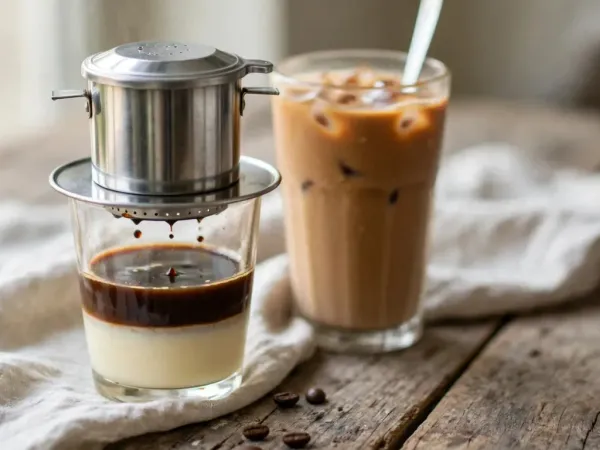
For cà phê trứng đá, pour the coffee over 1 cup (140 g) of ice in a short glass and spoon the cream on top. The cream sets a little firmer on cold coffee. Hanoi cafés such as Café Đinh serve it iced as well as hot.
Egg cocoa and egg matcha
Café Giảng also whips its egg cream over hot cocoa, matcha and even beer. For egg cocoa, stir 1 tablespoon (5 g) of cocoa powder and 1 teaspoon (4 g) of sugar into ⅓ cup (80 ml) of hot milk. Then spoon the cream on top.
A splash of spirits
Follow the Metropole and add 1 teaspoon (5 ml) of vodka, rum or brandy to the yolk before whipping. It makes an after-dinner drink.
Salt coffee
For a lighter topping with no egg, try salt coffee from Huế. It floats cream whipped with a pinch of salt over iced coffee.
Serving egg coffee as a Sunday dessert
Egg coffee is rich enough to replace dessert. Serve it at the end of a long lunch, after a classic pot roast or a pot of Italian Sunday gravy. It tastes like a tiramisu you can drink, and it takes 15 minutes.
For 4 guests, whip 4 yolks, ¼ cup (75 g) of condensed milk and 4 teaspoons (16 g) of sugar with an electric mixer for 4 to 5 minutes. Brew 4 phins at once, or make a strong pot in a moka pot and use ⅓ cup (80 ml) per cup. The cream loosens as it stands, so whip it last.
Calories and caffeine
One cup has about 135 calories. By USDA figures, the yolk brings about 55 calories and 184 mg of cholesterol, the condensed milk 61 calories and the sugar 16. The coffee is as strong as a glass of Vietnamese coffee, so count it as at least one full cup of regular coffee.
Substitutes for missing ingredients and equipment
- No phin: use ⅓ cup (80 ml) of strong coffee from a moka pot, or a double shot of espresso.
- No pasteurized eggs: heat the yolk mix to 160°F (71°C) over simmering water, as described above.
- No condensed milk: whip the yolk with 1 tablespoon (13 g) of sugar and 1 tablespoon (15 ml) of heavy cream. The cream will be lighter and less rich.
- No mixer: a balloon whisk or a handheld milk frother works. It just takes longer.
- Less caffeine: use a dark-roast decaf, ground medium-coarse.
Frequently asked questions
What does egg coffee taste like?
It tastes like a warm tiramisu in a cup. The cream is sweet and thick, like a light custard, and the coffee under it is strong and bitter. Stirred together, they taste like a rich, sweet latte.
Does egg coffee taste like eggs?
No. The condensed milk, sugar and coffee cover the taste of the yolk. At most, the cream has a faint custard note, and ¼ teaspoon of vanilla hides even that.
Is egg coffee safe to drink?
It is safe with a pasteurized egg. The yolk stays raw, and hot coffee does not cook it. The FDA advises pasteurized eggs for any dish served with raw egg. With regular eggs, heat the yolk mix to 160°F (71°C) over simmering water first.
Who invented egg coffee?
Nguyễn Văn Giảng, a bartender at the Metropole Hotel in Hanoi, created it in the 1940s. Fresh milk was scarce, so he whipped egg yolk into the coffee instead. His family still runs Café Giảng in Hanoi.
Can you make iced egg coffee?
Yes. Pour the coffee over ice, then spoon the egg cream on top. In Hanoi it is called cà phê trứng đá.
How long do you whip the egg for egg coffee?
About 2 to 3 minutes with an electric hand mixer, or about 5 minutes by hand. It is ready when it is pale, about triple in volume, and a ribbon of it holds its shape for 3 seconds.
How many calories are in egg coffee?
About 135 calories a cup, with 1 yolk, 1 tablespoon of condensed milk and 1 teaspoon of sugar. The yolk alone brings about 184 mg of cholesterol.