The Sunday Potthesundaypot.com/recipes/gajar-ka-halwa/
Gajar ka Halwa: Indian Carrot Pudding Slow-Cooked in Milk
By The Sunday Pot Kitchen Updated
- • Eight servings take 2 lb (900 g) of carrots, 4 cups (950 ml) of whole milk, ¾ cup (150 g) of sugar and ¼ cup (50 g) of ghee
- • Simmer the grated carrots in the milk for 45 to 60 minutes, stirring, until almost no milk is left
- • Add the sugar only then: it draws out liquid, so cook 10 to 15 minutes more
- • It is ready when the ghee shines at the edges of the pan
- • About 270 calories a serving and, made with orange carrots, about a day's vitamin A
- • Keep it 3 to 4 days in the fridge, and reheat it gently with a splash of milk
Ingredients
8 servingsInstructions
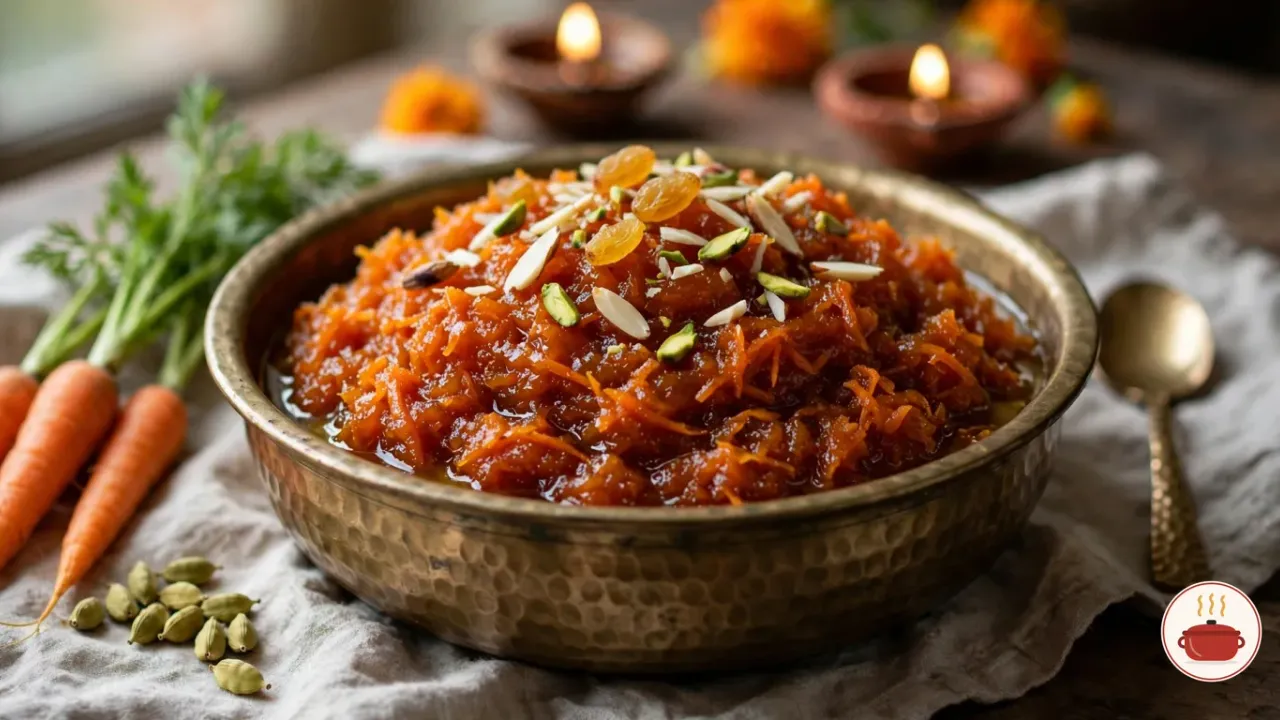
Gajar ka halwa is North India’s carrot pudding: grated carrots simmered in whole milk until the milk is absorbed, then cooked with sugar, ghee and cardamom until glossy. This version takes one wide pan and about 1 hour 40 minutes. It serves 8, warm or cold, and suits Diwali on Sunday 8 November 2026.
What gajar ka halwa is
Gajar means carrot in Hindi and Urdu. Halwa is a large family of sweets, made from flour, semolina, lentils, fruit or vegetables. The carrot one is soft, moist and spoonable, somewhere between a pudding and a jam. In Punjab it is also called gajrela.
It is one of the most popular desserts in North Indian homes, writes Rajyasree Sen in her book The Sweet Kitchen, excerpted by Scroll. The three main ingredients are cheap and easy to find, she notes, and it makes a warm dessert for Delhi’s cold winters.
Where halwa comes from
The word comes from the Arabic hulw, meaning sweet. The first known text to mention halwa is the Kitab al-Tabikh, an Arabic cookbook of the 13th century with 8 kinds, Sen explains. The food historian Colleen Taylor Sen dates halwa in India to the Delhi Sultanate, from the early 13th century. A cookbook written for the Sultan of Malwa in 1500 gives a recipe.
Carrot halwa’s undocumented past
Nobody knows when cooks first made halwa with carrots. One popular story says Sikhs from Punjab brought it to the Mughal court, but Gulf News tells it as a legend. We found no Mughal text that names it.
The carrots themselves arrived late. Purple and yellow carrots spread from Afghanistan to China, India and Japan in the 14th to 17th centuries. So say scientists of India’s vegetable research institute in a 2018 review. The orange carrot appeared in the Netherlands in the 17th century.
You may read that Dutch farmers bred orange carrots to honor William of Orange. There is no documentary evidence for it, the curator of the World Carrot Museum told Live Science.
Gajar ka halwa at Diwali and through the winter
Diwali on Sunday 8 November 2026
In 2026, Diwali falls on a Sunday. India’s central government lists it as a holiday on Sunday 8 November, says the Press Information Bureau. Drik Panchang gives Lakshmi Puja on the same day in Delhi, New York and London.
Halwa of some kind is a near-universal treat at Diwali, often made with carrots, writes Felicity Cloake in The Guardian. BBC Good Food calls it a dish often served at Diwali, to mark the change of seasons.
For the writer Amrita Gupta, Diwali meant her mother at the stove for most of the day, stirring pounds of carrots in milk. The halwa was offered at the prayers before anyone could eat it, she recalls in Edible Brooklyn.
A winter sweet, not only for Diwali
Gupta adds that it is a winter favorite, especially in North India, and not tied to Diwali alone. In Delhi, the arrival of winter is registered when a Connaught Place stall starts serving it again, notes The Delhi Walla. In Pakistan, its smell from the home kitchen is one of the first signs of winter, Gulf News reports.
Why gajar ka halwa fits this season
Regional Indian cooking is drawing attention. Mentions of authentic regional cuisine rose 39% in the year to May 2026 in the UK, by Tastewise data. The food supplier Bidfood quoted the figure in its 2027 trends, published by The Morning Advertiser on 1 October 2026. It named regional Indian dishes among the flavors to watch.
In the US, the research firm Datassential named Keralan food its cuisine to know for 2026, with 39% of Americans keen to try it. The consultants Baum + Whiteman forecast in November 2025 that Indian food would go luxury, naming upscale Punjabi cooking. They also called cardamom the next spice, for savory dishes.
The warm spices of chai are everywhere this fall. Tastepoint by IFF picked chai spice as one of 10 flavors for 2026. Three of the 6 new Starbucks drinks for fall 2026 are chai drinks, Food Republic counts.
Cardamom itself costs more this year. A weak monsoon and heat hurt the 2026 crop in Kerala, Onmanorama reported in June. At the 10 auctions from 28 September to 3 October 2026, small cardamom averaged about ₹3,190 a kilo. That is about 32% more than a year earlier, by our count of Spices Board India prices.
We found no sales or search figure for gajar ka halwa itself. The pull is the calendar: Diwali on a Sunday, and the first red carrots of the North Indian winter.
What you need for gajar ka halwa
Red Delhi carrots, or orange ones
North India’s halwa carrot is the red desi gajar, a winter crop. Red carrots get most of their color from lycopene, and orange ones from beta-carotene, the 2018 review explains. One red variety from India’s agricultural research institute is sown from August to early October and ready in 90 to 110 days. The National Horticulture Board gives those dates.
So in early November, red carrots are only starting to reach markets. In January 2026, the journal of ICAR, India’s farm research council, described a new red winter carrot, Pusa Prateek, as suited to halwa. Outside India, orange carrots work well. Use any carrots that are not fibrous, advises Dassana Amit of Veg Recipes of India, and add a little more sugar with orange ones.
Whole milk
You need 4 cups (950 ml) of whole milk, about 1 ml for each gram of carrot. Skim milk gives a thinner, less creamy halwa.
Ghee
Ghee is clarified butter, with the milk solids cooked out. It fries the halwa at the end and gives it its gloss. Butter works, but watch that it does not burn.
Cardamom
Every recipe we compared uses green cardamom. Grind the seeds of 8 pods just before you start, or use 1 teaspoon of ground cardamom.
Nuts and raisins
Almonds, pistachios and cashews are the usual nuts. About two-thirds of the recipes add raisins.
A wide, heavy pan
A heavy pan stops the milk from catching. Use one at least 11 inches (28 cm) across, so the milk can evaporate. The NYT Cooking recipe of the chef Cheetie Kumar warns against nonstick pans.
How to make gajar ka halwa in one pan
Grate the carrots
Grate 2 lb (900 g) of carrots, on the medium holes of a box grater or in a food processor. Finer shreds cook faster. Coarser ones keep more texture.
Simmer the carrots in milk
Across the 11 stovetop recipes we compared, the median is about 1 ml of milk per gram of carrot. Some cooks fry the carrots in ghee first, others reduce the milk alone first. This recipe simmers the carrots in the milk, the simplest way, for 45 to 60 minutes.
Stir every 3 to 4 minutes, and scrape the milk solids from the sides back into the pan. Those solids are a home-made khoya, and they make the halwa rich.
Add the sugar late
Add the sugar only once the milk has almost gone. Sugar releases a lot of moisture and makes the halwa gooey, warns Swasthi Shreekanth of Swasthi’s Recipes. Cook it for 10 to 15 minutes more, until it thickens again.
This recipe uses ¾ cup (150 g) of sugar for 2 lb (900 g) of carrots. That is on the less sweet side. The recipes we compared ranged from 110 to 300 g of sugar per kilo of carrots.
Finish in ghee
Fry the halwa in 3 tablespoons (40 g) of ghee for 5 to 8 minutes. Sautéing carrots in ghee gives them a more intense flavor, Cloake found. The halwa is done when the ghee shines at the edges of the pan.
Keep it moist
The finished halwa should still be soft and moist. Overcooked, it turns dry, Shreekanth notes. It also firms as it cools.
Shortcuts and variations
Khoya or milk powder
Khoya, also called mawa, is milk cooked down until much of its water is gone. Under India’s food rules it holds at least 55% milk solids, notes NIFTEM, a food processing institute. It is a classic shortcut for carrot halwa. Stir 4 oz (115 g) of crumbled khoya into the carrots once the milk has reduced. Or add ¼ cup (30 g) of milk powder at the end, for a slightly grainy finish.
Evaporated or condensed milk
Evaporated milk cuts the cooking time a lot. Cloake uses 1 cup (250 ml) in place of 2 cups (500 ml) of fresh milk. Sweetened condensed milk works too, in place of the sugar and most of the milk. Dassana uses one 14-oz (400 g) can for 3⅓ lb (1.5 kg) of carrots, with no other sugar.
Pressure cooker or Instant Pot
Dassana cooks about 4 cups of grated carrots with 1½ cups (360 ml) of milk, the sugar and the ghee for 3 minutes at high pressure. She releases the pressure, then stirs it on the sauté setting until thick. Double her quantities for this pan of 8 cups.
Vegan gajar ka halwa
Use oat, almond or cashew milk, and coconut oil in place of the ghee. Coconut oil brings its own aroma, Dassana warns.
Jaggery
Jaggery gives a deeper, caramel flavor. Some cooks warn that it can split the milk, so add it at the end, off the heat.
Serving and storing gajar ka halwa
Serve gajar ka halwa warm, with a spoonful of thick cream or vanilla ice cream. It is just as good cold from the fridge.
For a Diwali spread, serve it after a chicken biryani for 8. For another warm, nutty dessert, try black sesame soup. A pot of hojicha latte goes well with both.
Leftovers
Follow the USDA’s advice on leftovers:
- Refrigerate the halwa within 2 hours.
- Eat it within 3 to 4 days, or freeze it for 3 to 4 months.
- Reheat it in a pan over low heat with 1 to 2 tablespoons of milk, or eat it cold.
Calories, sugar and vitamin A
One serving, an eighth of the pan, has about 270 calories, 6 g of protein and 12 g of fat, by USDA figures. It has about 36 g of carbohydrate, including about 19 g of added sugar. That is about 38% of the 50 g Daily Value for added sugars that the FDA sets.
Carrots are rich in beta-carotene. Made with orange carrots, a serving has about 1,000 µg of vitamin A, or about 110% of the FDA’s 900 µg Daily Value. Red carrots give less, because lycopene has no vitamin A activity, explains Oregon State University’s Linus Pauling Institute. Cooking with fat helps your body absorb carotenoids, it adds.
Allergens
Gajar ka halwa contains milk, the ghee included, and tree nuts. Both are among the major food allergens the FDA lists. Leave out the nuts for a nut-free halwa.
Fixes for watery, dry, scorched or pale halwa
- Watery after the sugar: keep cooking and stirring for 5 to 10 minutes more. The sugar’s liquid always cooks off.
- Too dry: stir in ¼ cup (60 ml) of warm milk and cook for 2 minutes.
- Scorched taste: move the halwa to a clean pan without scraping the bottom, and keep the heat lower.
- Pale: cook it for 5 minutes more in the ghee, or add a pinch of saffron.
- Not sweet enough: stir in 1 to 2 tablespoons of sugar and cook for 3 minutes.
- Stringy carrots: grate them finer next time, and avoid old, woody carrots.
Substitutes for missing ingredients
- Red Delhi carrots: orange carrots, with 1 to 2 tablespoons more sugar.
- Whole milk: 2 cups (480 ml) of evaporated milk, which cuts the cooking time.
- Ghee: unsalted butter, or coconut oil for a vegan halwa.
- Cardamom pods: 1 teaspoon of ground cardamom.
- Sugar: ¾ cup (240 g) of sweetened condensed milk, or jaggery added at the end.
- Mixed nuts: any one of almonds, pistachios or cashews, or none.
Frequently asked questions
What does gajar ka halwa taste like?
It tastes of sweet carrots, cooked milk and cardamom, with a buttery richness from the ghee. It is soft and moist, a little like a warm, spiced carrot jam.
Is gajar ka halwa eaten hot or cold?
Both. Most families serve it warm, but it is also good cold from the fridge.
Can I make gajar ka halwa with orange carrots?
Yes. Orange carrots work well. They are a little less sweet than red Delhi carrots, so add 1 to 2 tablespoons more sugar.
Why is my gajar ka halwa watery?
The sugar went in too early, or it has not cooked long enough after the sugar. Keep stirring over medium heat until the liquid has gone.
Do I need khoya for gajar ka halwa?
No. The traditional way is to cook the carrots down in milk. Khoya is a shortcut that saves time.
How long does gajar ka halwa keep?
3 to 4 days in the fridge, or 3 to 4 months in the freezer.
Can I make gajar ka halwa ahead for Diwali?
Yes. Make it 1 or 2 days ahead, chill it within 2 hours, and reheat it gently with a splash of milk.
Is gajar ka halwa vegan?
Not usually, because it uses milk and ghee. Make it with plant milk and coconut oil for a vegan version.
What is the difference between gajar ka halwa and gajrela?
They are the same dish. Gajrela is its Punjabi name.