The Sunday Potthesundaypot.com/recipes/tahdig/
Tahdig: Persian Crispy Rice with a Golden Saffron Crust
By The Sunday Pot Kitchen Updated
- • Rinse aged basmati until the water runs clear, then soak it in salted water
- • Parboil it for 5 to 7 minutes, until soft outside with a firm core, and drain it
- • Press a thin layer of rice mixed with yogurt, egg yolk and saffron into hot oil
- • Mound the rest on top, cover with a towel-wrapped lid and steam on low for 35 to 45 minutes
- • Rest the pot on a damp towel, then flip the golden crust onto a platter
Ingredients
6 servingsInstructions
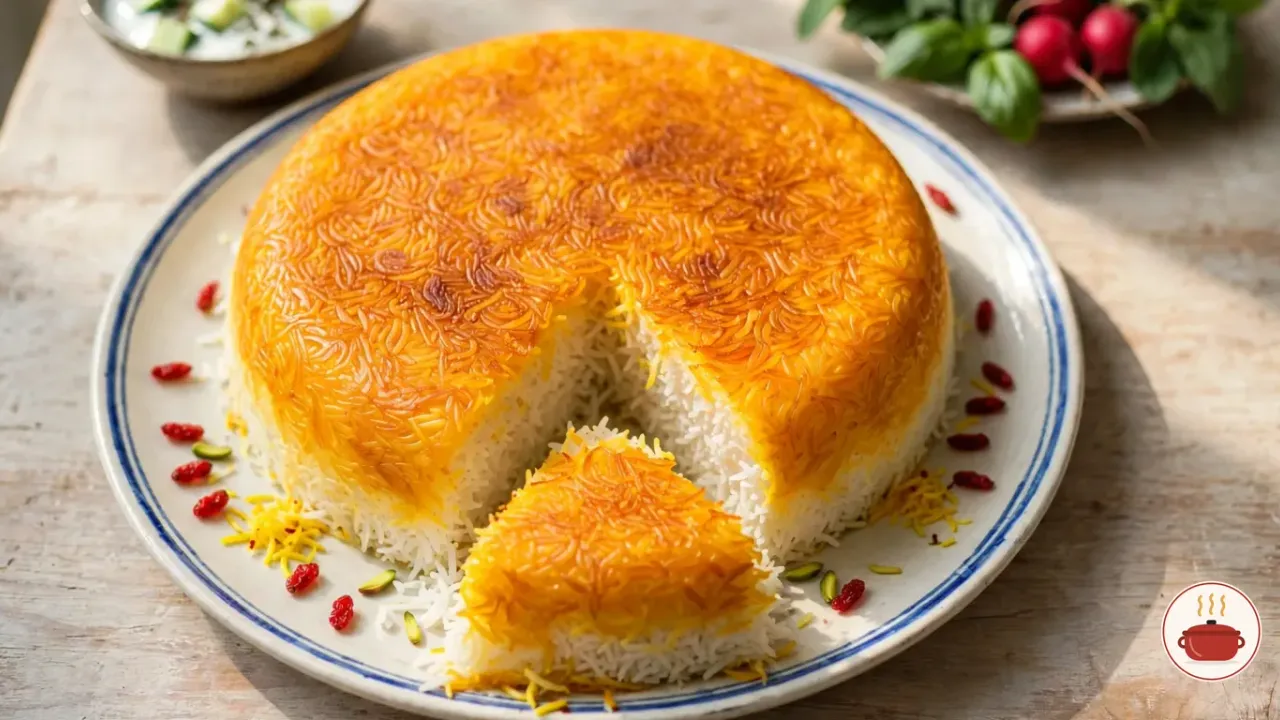
Tahdig is Persian crispy rice. You parboil long-grain rice, then steam it slowly in a pot with oil and butter, until the bottom layer turns into a golden, glassy crust. You flip the pot onto a platter and serve the crust on top of the fluffy rice. This recipe feeds 6 and takes about 2½ hours, most of it soaking and steaming.
What tahdig is
The bottom of the pot
Tah-dig means “bottom of the pot” in Persian. It is the crust that forms under Persian steamed rice, called chelow when plain and polow when mixed with herbs, meat or fruit. In most Iranian homes, it is the most wanted part of the meal.
“Tah-dig should be a golden color, never scorched or dark brown,” writes Najmieh Batmanglij in her classic book Food of Life. “The reputation of Iranian cooks rests on the quality of their tah-dig,” she adds, in the chelow entry that ckbk shows for free.
Not the same as tahchin
Tahchin is a different dish. It is a tall, sliceable cake of rice bound with yogurt, egg and saffron, yellow all the way through and often layered with chicken. Tahdig is white, fluffy rice with a thin crust only on the bottom. The food writer Shadi HasanzadeNemati calls the mix-up “one of the most common misconceptions” in her tahdig recipe.
Where tahdig comes from
Rice in Iran
Rice reached Iran from South and Southeast Asia. It was a staple by the Sasanian period at the latest, according to the Encyclopaedia Iranica. It grew best in the wet Caspian provinces of Gilan and Mazandaran, while bread was the everyday food on the dry plateau.
Two Safavid cookbooks, from 1521 and 1594-95, give recipes for polow. But Iranica says those recipes “differ from those in common use today, which seem to have originated in the Qajar period”. That period ran from the late 18th century to 1925. We could not read the Safavid texts, so we can’t say whether they describe a crust.
The word in a dictionary
The earliest dated use of the word we could find is in a Persian dictionary, the Farhang-e Anandraj, completed in 1888. Dehkhoda’s great dictionary quotes it: tahdig is food that has turned crisp and stuck to the bottom of the pot. Dehkhoda adds his own note on the rice grains that turn reddish and join together. You can read the entry on Vajehyab (in Persian).
The same entry records a joke. To “scrape the tahdig” was slang for playing the tar, a Persian lute, badly.
The towel on the lid
Iranian cooks steam the rice under a damkoni, a cover that soaks up steam. Iranica describes the old kind as “a flat round basket filled with straw or scraps of cotton material, then sewn into a cloth cover”. Today a clean tea towel around the lid does the same job.
Some Persian food sites tell a story about Naser al-Din Shah, a 19th-century king. His cooks fought over the crust, so he demanded it for himself. No source backs it up. Treat it as a kitchen legend.
Why tahdig is worth making now
Saffron season
Saffron colors the crust, and the new harvest is about to start. In Iran, “The annual harvest generally begins in early November,” the Tehran Times reported on October 27, 2026. The same story says Iran’s National Saffron Day festival, in Khorasan Razavi province, has joined the country’s calendar of international tourism events.
Iran grows “more than 90 percent of the world’s saffron”, Foreign Policy wrote in May 2026. It has been a hard year for that trade. The magazine reported that the war that began at the end of February had slowed Iranian exports through the Strait of Hormuz.
Rice on the move
The war also slowed the rice trade. India’s basmati exports fell 7% in January to April 2026, to 2.3 million tonnes, as shipments to markets including Iran declined. Two Indian officials gave those figures, reported in ESM Magazine in May. Iran was India’s biggest basmati buyer until Saudi Arabia overtook it last year.
Inside Iran, the rice harvest in Gilan began in late July. In Rasht county, machines started cutting 51,000 hectares of paddy, Mehr News Agency reported, in Persian. The governor expected more than 250,000 tonnes.
Two long nights and a new year
Iranians gather for Yalda, the winter solstice night, on Monday, December 21, 2026. UNESCO lists it as living heritage of Iran and Afghanistan. The spring equinox, which starts Nowruz, comes on the evening of March 20, 2027, Tehran time. At the New Year table, “everyone fights over the crust of crisp rice called tahdig,” writes Samin Nosrat in a herbed-rice recipe for NYT Cooking.
None of this is a fad, and we don’t call it one. Nobody has put a 2026 number on tahdig itself, whether sales, menus or searches. No 2027 trend forecast we read names it, or Persian food in general.
What 27 tahdig recipes agree on
We read 27 recipes in full and compared them. Thirteen are Iranian, in Persian, from sites such as Hamshahri Online, Namnak, Delgarm and Basalam. The other 14 are in English, from Najmieh Batmanglij, Samin Nosrat, America’s Test Kitchen, BBC Food and others.
Parboil, drain, steam
All but one parboil the rice in lots of salted water, drain it, then steam it. Persian cooks call this abkesh. The exception, a Persian guide, also explains kateh, rice cooked in just enough water.
A towel on the lid
Twenty-four of the 25 recipes that mention a lid wrap it in a towel. One Persian site says the cloth stops drops of steam from falling back on the rice and making it mushy (our translation). Most poke holes in the rice with a spoon handle, so steam can rise from the bottom.
High heat, then low
Eighteen of 25 start the pot on higher heat for a few minutes, then turn it low. Several Persian recipes add a warning. Keep the burner on until the very end, or the crust goes soft.
A nonstick pot
Of the 18 recipes that name a pot, 14 want nonstick. “The best pot you can use to make tahdig is a good nonstick pot,” HasanzadeNemati writes. America’s Test Kitchen uses a Dutch oven but suggests nonstick if you have one.
The numbers
The median parboil is about 5½ minutes, and the median steam is 41 minutes. Persian recipes steam a little longer, about 44 minutes. The median recipe uses about 3 oz (92 g) of raw rice per person.
The splits: soaking and the base
The Persian recipes soak the rice far longer, a median of 2½ hours against 30 minutes in the English ones. Three English recipes skip the soak. We chose 1 to 2 hours, which gives long, unbroken grains without planning a day ahead.
The base layer splits the field. Fifteen of 25 use rice mixed with yogurt and saffron, and 11 of those 16 yogurt bases add egg. Without egg, Persian cooks say, the crust won’t come out in one piece. Four use potato, four plain rice and two flatbread.
Yogurt, potato or bread
Yogurt and saffron
This is the crust in our recipe. It sets into a golden cake with each grain still visible. Use thick yogurt; a Persian cook on Basalam warns that watery yogurt makes the crust fall apart. There, saffron tahdig is “an unwritten rule” when guests come (our translation).
Potato
Thin potato rounds turn into a crisp golden mosaic. Slice them about ⅛ inch (3 mm) thick and pat them dry. They need closer watching, so check the color at the edge after 40 minutes.
Lavash
Flatbread is the easiest crust to get right, according to a Persian guide on Roozaneh. Lay lavash or a large flour tortilla in the oil, as Nosrat does in her polo ba tahdig. In her words, you then “gather your courage, praise your ancestors and flip the rice.”
Tips for a crust that releases
- Use a nonstick pot with a heavy base, about 9 to 10 inches (24 to 26 cm) across.
- Rinse the rice well. Loose starch makes the grains stick together.
- Check the grains, not the clock, when you parboil. A firm center is what you want.
- Keep the crust layer thin. A thick layer stays soft in the middle.
- Listen. A steady crackle at the start means the crust has begun to form.
- Rest the pot on a damp towel before you flip. America’s Test Kitchen says not to skip this step.
Serving tahdig
Serve the rice on the platter with the crust on top, and break it into pieces at the table. Some Iranian cooks spoon the rice onto a platter and serve the crust on its own plate.
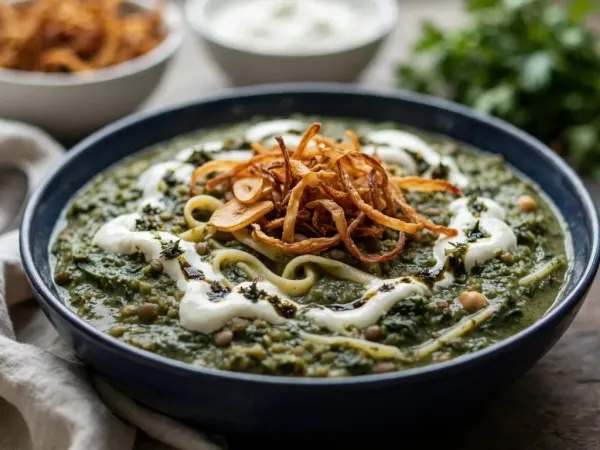
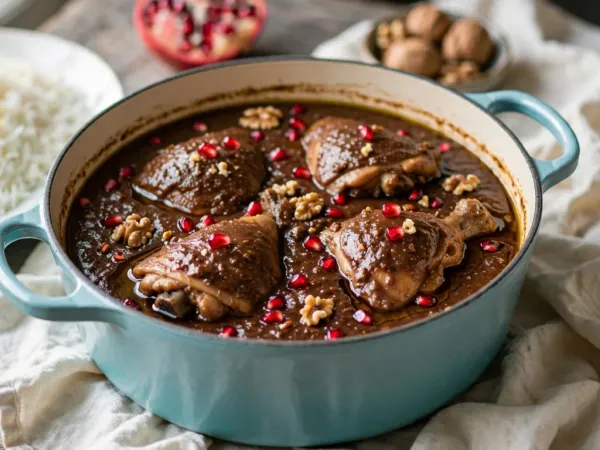
Tahdig goes with any Persian stew. Try it with tangy fesenjan, the pomegranate and walnut stew, or after a bowl of ash reshteh. Add plain yogurt with cucumber and a plate of fresh herbs. For a Yalda spread, finish with pomegranate seeds and nuts.
If it sticks, don’t panic. Lift the crust off in pieces and lay them on the rice. “This is a perfectly acceptable way to serve it,” say the Hairy Bikers at BBC Food.
Safety, storing and nutrition
Golden, not dark
Britain’s Food Standards Agency advises cooks to “aim for a golden yellow colour or lighter” when they fry starchy foods. Browning starch at high heat makes acrylamide, a chemical the agency wants us to eat less of. That matches Batmanglij’s rule. Stop at gold, especially with potato or bread.
Rice and arsenic
Rice takes up more arsenic than other grains. Cooking rice in plenty of water and draining it can cut the inorganic arsenic by 40 to 60%, the FDA says. Tahdig only parboils the rice in lots of water, so expect a smaller drop than that. Rinsing, the FDA adds, has little effect on arsenic.
Hot pans and hot oil
Never heat a nonstick pot empty. Above 260°C (500°F), the coating can start to give off fumes, Singapore’s food agency warns, and an empty pan gets there fast. Put the oil in first.
Keep the towel corners tied up on the lid, away from the flame. Wear oven mitts to flip, and tip any loose oil into a bowl first. If hot oil touches your skin, cool the burn under running water for 20 minutes, as the NHS advises.
Allergens
The yogurt crust contains milk and egg, and the butter is milk too. A bread crust adds wheat. For a version without milk, egg or wheat, use oil instead of butter and a potato or plain saffron-rice base.
Storing
Eat the crust the day you make it, while it is crisp. Leftover rice needs care, because the spores of Bacillus cereus survive cooking. The Food Standards Agency says to cool rice within an hour and keep it chilled no more than a day. Reheat it only once, until it steams all the way through. Spoon leftovers out of the pot; don’t leave them to cool there.
Nutrition
One serving, a sixth of the pot with the yogurt crust, has up to about 480 calories. It has about 7 g of protein, 17 g of fat and 74 g of carbohydrate. These are our sums from USDA values for long-grain white rice, oil, butter, yogurt and egg yolk. Some fat stays in the pot. We can’t estimate sodium, because most of the salt drains away with the water.
Fixes for soft, stuck or burnt tahdig
- The crust is pale and soft: the heat was too low or the layer too thick. Next time, give it 10 minutes at medium-high.
- It stuck to the pot: use a nonstick pot, more oil and the damp-towel rest. Lift the pieces out with a spatula and lay them on the rice.
- It smells burnt: take the pot off the heat. Lift out the good rice without scraping the bottom, then lower the heat next time.
- The rice is mushy: you boiled it too long. Drain it while the core is still firm.
- The grains break: stir gently, and soak the rice for longer.
Substitutes for missing ingredients
- Aged basmati: any long-grain white rice. Avoid short-grain and sticky rice.
- Saffron: a pinch of ground turmeric in the yogurt colors the crust, but loses the scent.
- Yogurt and egg: potato slices or lavash.
- Butter: more oil or ghee.
- Nonstick pot: a well-seasoned cast-iron pot, with an extra tablespoon of oil.
Frequently asked questions
What does tahdig mean?
“Bottom of the pot”. Tah means bottom, and dig means pot.
What rice is best for tahdig?
Aged basmati or Iranian long-grain rice. The long grains stay separate and fluffy.
Why didn’t my tahdig come out in one piece?
The pot may have needed more oil, or the egg was missing from the base. Rest the pot on a damp towel before you flip.
Can I make tahdig in a rice cooker?
Yes. Many Iranian families use rice cookers with a nonstick bowl made for tahdig.
Is tahdig gluten-free?
The rice, yogurt and potato versions contain no gluten. Lavash or tortilla versions do.
How is tahdig different from tahchin?
Tahchin is a whole cake of yellow rice bound with yogurt and egg. Tahdig is just the crust under white rice.