The Sunday Potthesundaypot.com/recipes/lomo-saltado/
Lomo Saltado: Peruvian Beef Stir-Fry with Fries and Rice
By The Sunday Pot Kitchen Updated
- • Cut the beef into thick strips and sear it in batches in a smoking-hot wok or thin skillet
- • Fry the potatoes twice, at 325°F (160°C) and then 375°F (190°C), so they stay crisp
- • Onion, ají amarillo and tomato wedges go in last and cook for only a minute or two
- • Pour about 2 parts soy sauce to 1 part vinegar down the sides of the pan
- • Toss half the fries through the sauce, pile the rest on top, and serve with white rice
Ingredients
4 servingsInstructions
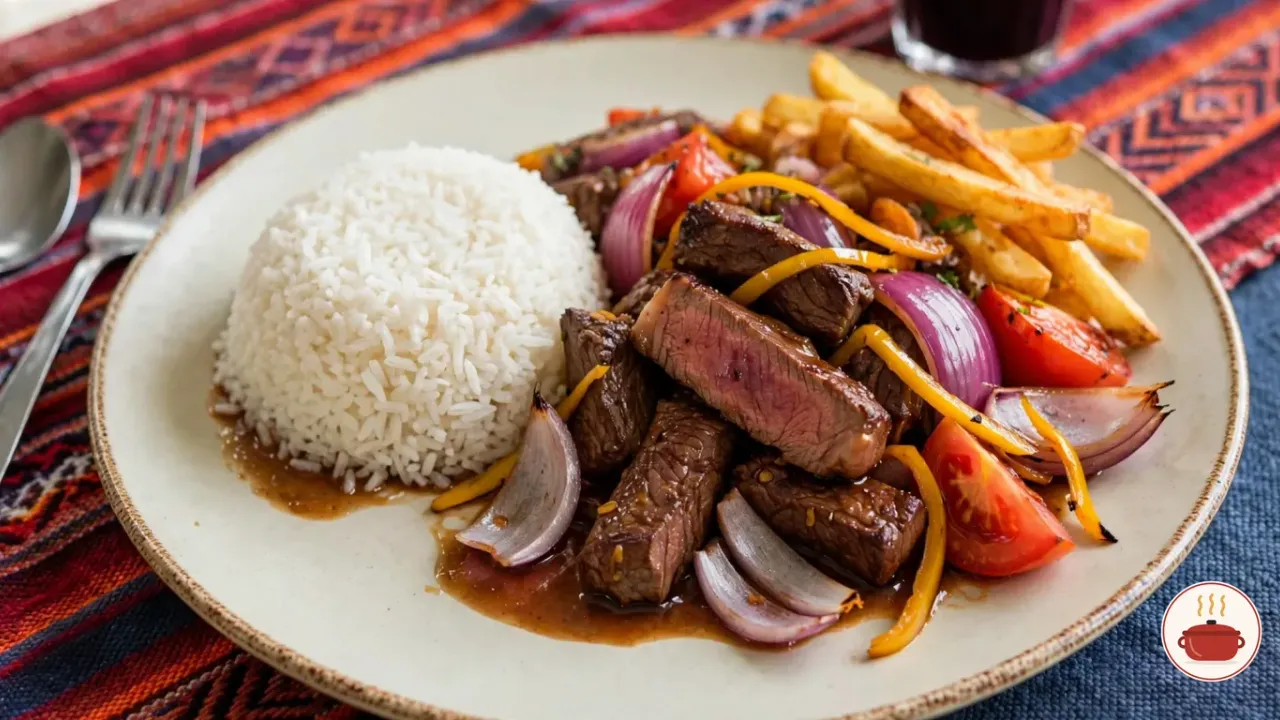
Lomo saltado is Peru’s beef stir-fry. Strips of beef are seared in a very hot wok with red onion, tomato and yellow ají amarillo chile, in soy sauce and vinegar. It comes with crisp fries, some tossed through the sauce, and white rice. It takes about 1 hour for 4 plates.
What lomo saltado is
A Chinese wok meets Peruvian fries
Lomo is beef loin and saltado means tossed in a hot pan. The dish belongs to two kitchens at once. In Peru’s Chinese restaurants, the chifas, “lomo saltado simply means stir-fried beef”, the food writer Nicholas Gill explains in New Worlder. There it is beef and onion with soy and vinegar, served with rice.
The criollo version, the one most people know, keeps the onions and the beef. It “also adds tomato, ají amarillo, cilantro, and fried potatoes,” Gill writes. That is the version below.
Fast, hot and juicy
Everything happens in a few minutes. The chef Ricardo Zarate says the final stir-fry should take no more than about 90 seconds. Visiting family in Lima, he once watched a TV cook-off where the fastest cook finished “at just under ninety seconds”, he recalls in his recipe.
The vegetables should stay in big, visible pieces. Don’t cut the onion and tomato too small, the Peruvian edition of Infobae warns in an October 2026 recipe. They should stay slightly crunchy (our translation).
Where lomo saltado comes from
The wok arrives
Chinese contract workers, most of them Cantonese, began arriving in Peru in 1849. They brought their seasonings and their tools, and the most important was the wok, El Comercio wrote in 2011. When their contracts ended, many opened small eating houses. By about 1921 people called them chifas, the researcher Gloria Hinostroza told the paper.
PromPerú, the national promotion agency, tells a similar story on its travel site. In the late 19th century, it says, Cantonese cooks in Lima kitchens brought in the technique of cooking in a wok.
Beef and fried potatoes first
The fries came before the soy sauce. The historian Sergio Zapata Acha quotes one of the earliest recipes, from the 1920s: beef cut in strips, fried in lard, salted and served with fried potatoes. He calls it a version of lomito a la vaca, a dish already found in Peruvian recipe books at the end of the 19th century.
Peruvian creole cooking had the other pieces ready. In a 2019 peer-reviewed paper, Zapata Acha names bistec a la chorrillana as a forerunner of lomo saltado. It combined onion, garlic, ají, vinegar, tomato, potato and beef. Gastón Acurio, Peru’s best-known chef, has said that in the 1940s the fries came on a separate plate. That is a chef’s view, not a document.
Old cookbooks are now heritage
In February 2026, Peru’s Ministry of Culture declared nine historical cookbooks national cultural heritage. All belong to the National Library of Peru and date from 1902 to 1962. One is Chifa: recetas de arte culinario chino, from 1954, which the library says documents how Chinese cooking adapted to Peru. The library does not say whether any of them includes lomo saltado.
A claim we could not confirm
Some English sources say lomo saltado first appeared in a Peruvian cookbook of 1903. We traced that claim to a Cuban cookbook by José E. Triay. We searched a scanned 1914 edition, all 313 pages, and the word saltado never appears. So we cannot say when the dish was first printed.
Why lomo saltado fits this November
The 50 Best comes to Lima
On Wednesday, November 4, The 50 Best Restaurants announces its 1-50 ranking in Lima. The list’s organizers published the restaurants ranked 51 to 100 on October 21, in a press release. Over 1,100 experts voted.
Peru has one restaurant in that part of the list: Mil, in Cusco, at No. 95, La República of Colombia noted. Any Lima restaurants on the list will learn their place on the night.
A year of expensive yellow chiles
Ají amarillo, the fruity yellow chile in this dish, had a wild year in Lima’s markets. In July, it had the biggest price rise of all 586 products in Lima’s consumer price basket, up 47.04% in one month. Peru’s statistics office INEI published the figure, and Gestión reported it on August 1.
In August, ground ají amarillo rose another 28.57%, the biggest rise again, INEI reported. In September, the chile fell back by about 16%, and tomatoes rose 28.92% instead, according to INEI’s September note. These are changes from one month to the next, not over a year.
No number for the dish itself
We looked for a 2026 sales figure, search count or survey for lomo saltado and found none. INEI does not single out beef in these notes, so we can’t say beef got dearer. The news this autumn is the 50 Best and the price of its chile.
What 29 lomo saltado recipes agree on
We compared 29 published lomo saltado recipes. Fourteen are Peruvian, in Spanish: Gastón Acurio, El Comercio’s food pages, Buenazo, Yanuq, Nestlé Perú, Perú Delicias, Infobae Perú and others. The rest include the chefs Martin Morales and Ricardo Zarate, America’s Test Kitchen, NYT Cooking and Bon Appétit.
The same order, at high heat
Every recipe follows nearly the same order. The beef sears first over high heat, then the onion goes in, then the tomato, then the soy and vinegar. Several cook the beef in batches. Nestlé Perú browns it in 4 batches, its recipe says, so the meat doesn’t stew.
Two parts soy, one part vinegar
Per 4 servings, the medians are 4 tablespoons of soy sauce and 2 tablespoons of vinegar. Red wine vinegar is the most common. Acurio goes the other way. In a 2018 radio segment, he asked for “8 cucharadas de vinagre mezcladas con 4 cucharadas de sillao”, twice as much vinegar as soy sauce, RPP reported.
Fresh ají amarillo in Peru
Thirteen of the 14 Peruvian recipes use fresh ají amarillo, cut in thin strips. Recipes from abroad often swap in jalapeño, serrano or a yellow bell pepper. Tomatoes go in as wedges in all 29.
Fries in the pan or beside it
This is the main split. Thirteen recipes serve the fries on the side, and 9 toss them into the pan. Acurio mixes in half and piles the rest on top, so you get two textures. Buenazo leaves it to you. Mix them in to soak up the juices, it says, or keep them beside the beef so they stay crisp.
Beef, cumin and pisco
Tenderloin is the first choice in 20 of the 29. The median is about 570 g of beef for 4 servings, and 750 g in the Peruvian recipes. Cumin appears in 9 recipes and oyster sauce in 8. Only 6 flambé the pan with pisco, Peru’s grape brandy, and 2 of those say it is optional.
How to sear lomo saltado without stewing it
- Heat the pan properly. La Gastronauta, writing in El Comercio’s food section, heats the pan for about 2 minutes, until the oil smokes well.
- Work in batches. Too much beef at once cools the pan, and the meat simmers in its juices.
- No wok? Use a thin pan. Acurio suggests a thin-bottomed skillet that heats up quickly, with everything ready before you start.
- Pour the sauce down the sides. Perú Delicias adds the soy and vinegar around the edges of the pan, where they sizzle.
- Tomatoes go in last. They should soften at the edges but keep their shape.
- Keep the onion crisp. Cook it for a minute only. The cook Nelly Rosinelly, on Buenazo, keeps the wedges in ice water until it is time to cook them.
Ways to vary lomo saltado
- Pollo saltado: chicken thigh strips instead of beef, cooked through.
- Tallarín saltado: toss the stir-fry with noodles instead of fries.
- Tacu tacu con lomo: serve it over a crisp cake of fried rice and beans.
- A lo pobre: top each plate with a fried egg and fried plantain.
- Chifa style: no tomato and no fries, just beef, onion, soy and rice.
- Mushroom saltado: thick slices of king oyster or portobello mushrooms for a meatless plate.
Serving lomo saltado
Serve it the moment it leaves the pan. The Peruvian recipe site Yanuq unmolds a dome of rice in the center of the platter. The fries go on one side and the beef on the other. In a 2013 BBC Food recipe, Martin Morales also sets the steak and chips side by side. Make sure everyone gets some of the juices for their rice.
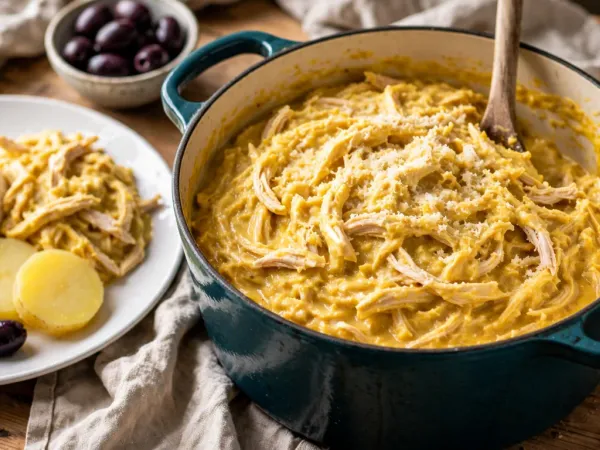
For a Peruvian meal, start with creamy ají de gallina on another night. Finish with turrón de Doña Pepa, Lima’s anise and honey candy. If you like wok-fried beef, Sichuan mapo tofu is another fast stir-fry.
Safety, storing and nutrition
How done the beef should be
Lomo saltado strips are usually still pink in the middle. The USDA’s safe temperature chart sets 145°F (63°C) for beef steaks, with a 3-minute rest. Thin strips cooked rare will not reach that. If you want them pink, use a whole cut, not mechanically tenderized beef. For anyone at higher risk from food poisoning, such as pregnant women, cook the strips through.
Frying the potatoes safely
Frying oil can heat to over 400°F (204°C). Water turns to steam the instant it hits oil that hot, the USDA explains in its guide to deep frying. So dry the potatoes well before they go in. Never leave the pot. If the oil catches fire, never pour water on it: cover the pot with a metal lid and call 911.
The first cooking safety rule of the US Fire Administration is to stand by your pan. It also says to turn pot handles toward the back of the stove. Let the oil cool, strain it and keep it in a sealed, dark container, or throw it out. Never pour it down the sink.
Pisco in a hot pan
The pisco is optional, and the dish tastes right without it. If you use it, take the pan off the burner first, never pour from the bottle, and keep a lid close by. That is common kitchen practice, not official guidance. Buenazo’s own recipe warns that the flame can be high.
Leftovers
Keep the stir-fry and the fries apart, because the fries go soggy. Refrigerate both within 2 hours, and eat them within 3 to 4 days. Reheat the beef in a hot pan until it is steaming, to 165°F (74°C), and crisp the fries in the oven. In Peru, leftovers often become tacu tacu.
Allergens
Most soy sauce contains soybeans and wheat, so the dish contains both. Oyster sauce, if you add it, contains shellfish. For a gluten-free plate, use a tamari labeled gluten free. Some frozen fries share a fryer with other foods, so check the package.
Nutrition
One plate, with fries and rice, has about 880 calories, 46 g of protein, 35 g of fat and 93 g of carbohydrate. We estimated these from USDA FoodData Central values for tenderloin, red onion, tomato, potato, oil, soy sauce and rice. USDA has no entry for ají amarillo, so we used red chile as a stand-in.
It is salty. A plate has about 1,450 mg of sodium, much of it from the soy sauce. If that matters to you, use a lower-sodium soy sauce and salt the fries lightly.
Fixes for gray, soggy or flat lomo saltado
- The beef is gray and wet: the pan was not hot enough, or too much meat went in. Sear in smaller batches.
- The fries are soggy: they sat in the sauce too long. Toss in only half, just before serving.
- The tomatoes turned to sauce: they cooked too long. Add them last and take the pan off within a minute.
- It tastes flat: add a splash of vinegar and a pinch of salt. The sauce should be tangy.
- It is too salty: add a little stock or water, and use less soy sauce next time.
- The onion is limp: it cooked too long. One minute over high heat is enough.
Substitutes for missing ingredients
- Fresh ají amarillo: frozen ají amarillo, 1 tablespoon of ají amarillo paste, or a jalapeño with a strip of yellow bell pepper.
- Beef tenderloin: sirloin, or flank cut across the grain.
- Red wine vinegar: white wine vinegar, or lime juice added at the end.
- Yellow potatoes: russets, or good frozen fries baked until crisp.
- A wok: a wide, thin skillet that heats fast.
- Pisco: leave it out; a splash of white wine also works.
Frequently asked questions
Is lomo saltado Chinese or Peruvian?
Both. Cantonese cooks brought the wok and their seasonings to Peru. Peruvian cooks added tomato, ají amarillo and fries.
Are the fries mixed in or served on the side?
Either way. Of the recipes we read, 13 serve them on the side and 9 toss them in. Half and half gives you crisp fries and soft ones.
What cut of beef is best for lomo saltado?
Tenderloin, or lomo fino, is the classic. Sirloin is cheaper and works well.
Is lomo saltado spicy?
Not very. Ají amarillo is fruity and only moderately hot, and the seeds come out.
Can I make lomo saltado without a wok?
Yes. Use a wide, thin skillet over your highest heat and cook the beef in small batches.
Do I need pisco?
No. Most of the recipes we read leave it out.