The Sunday Potthesundaypot.com/recipes/kibbeh-bil-saniyeh/
Kibbeh bil Saniyeh: Lebanese Baked Kibbeh with Pine Nuts
By The Sunday Pot Kitchen Updated
- • Use about half as much fine bulgur as lean meat by weight: 250 g bulgur to 500 g meat
- • Keep each paste layer thin, about ⅓ inch (1 cm), so the tray stays crisp, not stodgy
- • Cool the filling of meat, onion and pine nuts before it goes between the layers
- • Bake at 400°F (200°C) for 35 to 40 minutes, until the center reaches 160°F (71°C)
- • Freeze the tray unbaked and without the oil; add the oil when it goes in the oven
Ingredients
8 servings, one 12-inch (30 cm) round trayInstructions
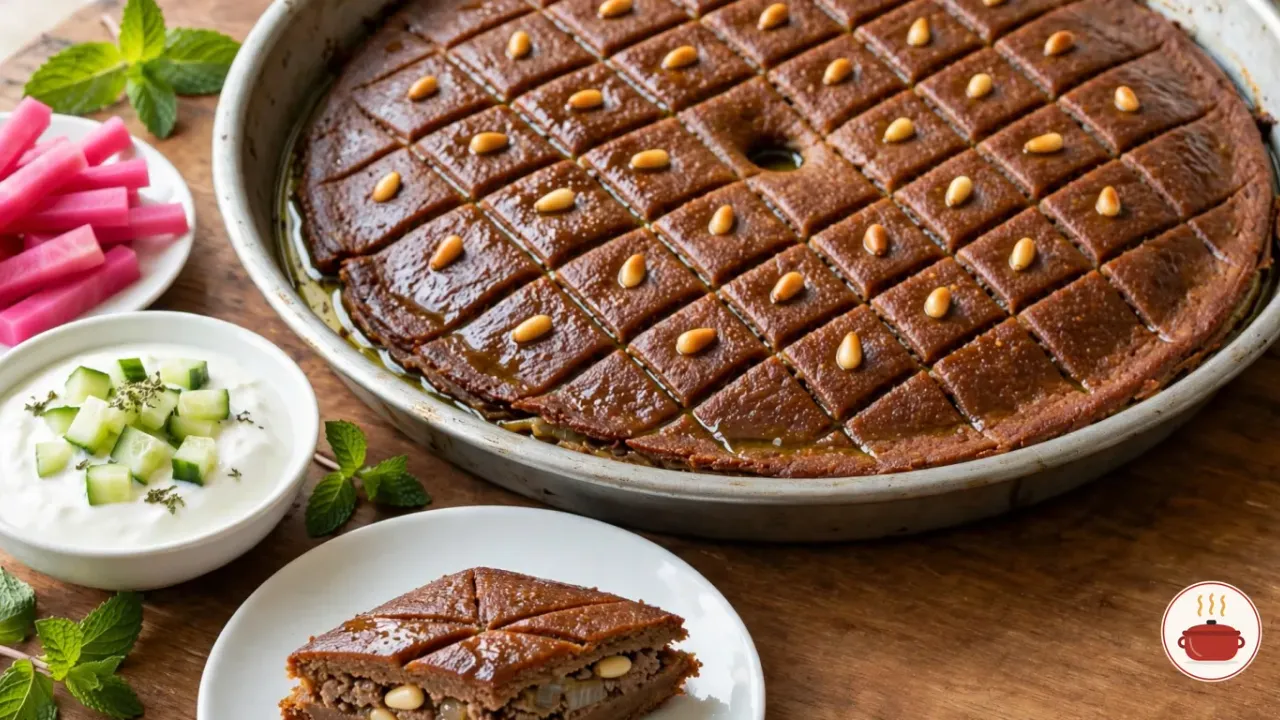
Kibbeh bil saniyeh is Lebanon’s baked tray kibbeh. A paste of fine bulgur, lean meat and onion makes a thin top and bottom layer. Between them sits a filling of spiced meat, onion and toasted pine nuts. The top is scored in diamonds and baked with olive oil. This recipe serves 8 in about 2 hours.
What kibbeh bil saniyeh is
A tray, not a meatball
Kibbeh is a family of dishes built on one dough: bulgur pounded with meat. Saniyeh means a tray, so this is the version spread in a pan and baked. Lebanese cooks also shape the same paste into stuffed balls, simmer them in yogurt, or eat it raw as kibbeh nayyeh.
“Kibbeh is the Lebanese dish par excellence,” writes the Lebanese food blog Dina’s Kitchen. Maureen Abood, a Lebanese-American food writer, describes her round tray as scored in diamonds “that form a kind of geometric flower”.
Why the layers are thin
Thin layers are the point. “If you make it too thick it becomes too stodgy,” warns the Lebanese food blog Zaatar and Zaytoun, which asks for layers 1 cm thick. Abood thinned hers over the years to about a quarter inch, for “an even less meatloaf-y, more delicate kibbeh”.
Where tray kibbeh comes from
Medieval kubba were meatballs
The word comes from the Arabic kubba, from a root meaning to roll into a ball. In the 10th-century Baghdad cookbook of Ibn Sayyar al-Warraq, kubab are balls of pounded meat and onion boiled in water. A cookbook by al-Baghdadi, from 1226, adds a peeled pistachio inside each ball. Neither has bulgur, a shell or a tray.
Mortars in Sidon, 1850s
The oldest description of tray-baked kibbeh we could read comes from William M. Thomson, a US-born minister. In Sidon, now in south Lebanon, he heard wheat being pounded in stone mortars “to make kibby, the national dish of the Arabs”. Every family owned such a mortar, he wrote in The Land and the Book.
Kibbeh was most often made of mutton with fat from the sheep’s tail, Thomson noted. Once pounded, “it is sent to the oven, and baked in a copper dish made for the purpose”. On the day he describes, the boy of the house pounds fish instead, for kibbet samak.
Beirut’s first printed recipe, 1885
Khalil Sarkis’s Beirut cookbook of 1885 gives 15 kinds of kibbeh. So write the historians Graham Auman Pitts and Michel Kabalan in Making Levantine Cuisine (University of Texas Press, 2021). The first is the tray. It uses more bulgur than meat, a filling of meat fried in ghee with onions and pine nuts, and a thicker top layer than bottom. “Cut it like baklava,” Sarkis tells the cook, then put ghee on top and bake.
The same book has pumpkin, potato, fish and octopus kibbeh. Pitts and Kabalan tie those to the Christian fast days, when meat was off the table.
When it became “Lebanese”
A 1948 US government guide to Beirut called kibbeh a “glorified hamburger”. By 1953, a Beirut guidebook was introducing it as “the national dish of Lebanon”, Pitts and Kabalan note. Their view is that kibbeh became Lebanese as the country’s cuisine was written down in the second half of the 20th century.
No Lebanese government text names a national dish, and Syria claims kibbeh too. So call it “often called Lebanon’s national dish”. Machines changed the work. By its 1969 edition, George al-Rayyis’s cookbook offered the food processor beside the stone mortar, plus ice to help the meat bind.
Ehden, Zgharta and a 233 kg record
The north of Lebanon takes kibbeh seriously. On August 29, 2009, the group Almidan made the largest kibbeh on record in Ehden, at 233 kg (514 lb), Guinness World Records says.
In nearby Zgharta, the Lebanese food blog NoGarlicNoOnions found kibbeh bakeries that fill trays with goat meat. They bake them covered in oil, in very hot ovens. Until the 1970s, meat cost so much that eating kibbeh was a luxury, the cookbook author Chérine Yazbeck told La Libre Belgique in 2014 (our translation).
Kibbeh and Lebanon in November 2026
Independence Day, 83 years on
Lebanon marks Independence Day on November 22. The Lebanese Army dates “the dawn of independence” to November 22, 1943, so 2026 brings the 83rd anniversary. It falls on a Sunday this year.
Lamb up 16.84% since January
Meat is the costly part of this tray. Between January 5 and October 5, 2026, local fresh lamb rose 16.84%, from 1.92 million to 2.24 million Lebanese pounds a kilo. The figures come from the Ministry of Economy and Trade’s weekly food basket, compared by the Beirut daily Annahar on October 16. Meat as a whole rose 17.26%; the cereals group fell 3.86%.
Inflation at 17.53%
Lebanon’s Central Administration of Statistics put yearly inflation at 17.53% in September 2026. Food and soft drinks cost 10.04% more than a year before. Meat eased, though: by our reading of the agency’s tables, its index fell 2.03% between August and September.
A wheat harvest near average
Lebanon’s 2026 cereal harvest came to about 160,000 tonnes, near the five-year average and well up on the drought year before, the FAO’s GIEWS country brief says. It put food inflation at 18% in June. We found no 2026 price for bulgur itself.
Kibbeh in the shelters
The year has been hard. On May 10, World Central Kitchen published a kibbeh recipe cooked for displaced families in Lebanon. It is kibbeh labanieh, balls in yogurt, not the tray. Since March 2, its teams had served more than 1.7 million meals, the charity said.
Nobody has put out a 2026 count, sales total or festival for the baked tray itself, as far as we could find. The hooks this month are the calendar and the price of its meat.
What 32 kibbeh recipes agree on
We counted 32 published recipes. Twenty-seven come from Lebanese or other Arab authors and outlets, and 10 were first written in Arabic. One more was an Arabic copy of a recipe we already had, so it counts once.
Two layers and a cooked filling
Thirty-one of the 32 use two layers of raw paste around a cooked filling. Only one is a single layer. Every recipe that names the bulgur grade asks for fine (#1). Coarse bulgur “will not work in this recipe”, the blog Hungry Paprikas says.
About half as much bulgur as meat
The median is 270 g of fine bulgur for every 500 g of shell meat. The cookbook author Claudia Roden gave the same ratio in 1986: 500 g of meat to 250 g of bulgur. Sarkis, in 1885, used more bulgur than meat.
Lean meat, ground fine
Eighteen recipes call for lean meat, and 16 grind it twice or more. “In Lebanon, butchers create a super fine mince when we ask them for kibbeh meat,” says the Lebanese site The Matbakh. Abroad, it advises, give the meat a few more turns yourself.
Beef, lamb or either
Eleven recipes use beef only and 4 lamb only. Ten take lamb or beef, and a few use veal. The cuts named include leg of lamb and beef sirloin.
Spices: seven-spice first
Eighteen season the shell with seven-spice, allspice or another baharat. Black pepper appears in 14, cinnamon in 11, dried mint in 9 and basil in 7. Six add marjoram. “My mother loved marjoram in it,” Dina’s Kitchen writes, so this recipe uses it.
Pine nuts in the middle
Pine nuts go into 24 of the 31 fillings, a median of 35 g. Six add walnuts and six pomegranate molasses. Four use sumac.
Oil or butter on top, and two ovens
Twenty-two pour some oil over the top, 12 of them olive oil. Sixteen use butter or ghee, and some use both. Baking splits into two camps: about 350°F (175°C to 180°C) for 25 to 45 minutes, or 400°F (200°C to 205°C) for 40 to 60 minutes. The median is 191°C (375°F).
Variations across Lebanon
- Pumpkin kibbeh: pumpkin replaces the meat. The Matbakh calls it a vegan version popular during Lent.
- Fish kibbeh: Thomson ate it in Sidon in the 1850s, and Sarkis has it too.
- Potato kibbeh: another meatless shell, also in Sarkis.
- Goat filling: the Zgharta style, baked under oil.
- Raw kibbeh nayyeh: a Lebanese classic, but this site doesn’t make it (see the safety section).
Tips for a crisp, even tray
- Squeeze the bulgur dry. Do it by the handful, right before it goes in.
- Keep everything cold. Ice water helps the paste bind, a trick Pitts and Kabalan find in the Rayyis cookbook.
- Cool the filling. Several recipes insist on it before the top goes on.
- Patch the top in discs. Small pieces flattened between wet palms are easier than one big sheet.
- Make a hole. Rose Nader, in a recipe on NPR, pushes a finger into the center for “a hole about the size of a nickel”. Dina’s Kitchen fills it with olive oil.
- Cut once it rests. The Matbakh warns that hot pieces crumble.
Serving kibbeh bil saniyeh
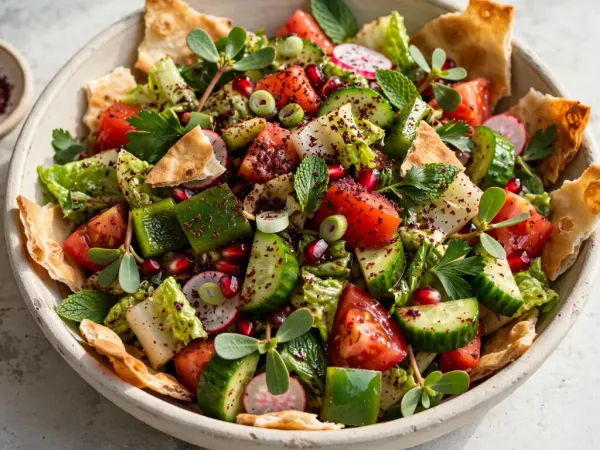
Bring the tray to the table and lift out the diamonds. Plain yogurt is the pairing most recipes name, or yogurt with cucumber and dried mint. Add pickles, radishes and a salad such as fattoush.
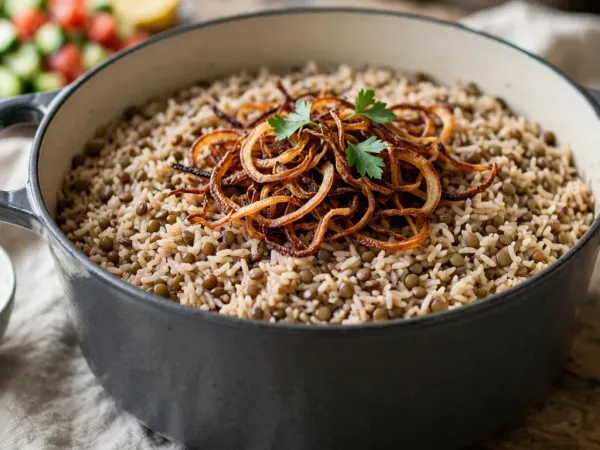
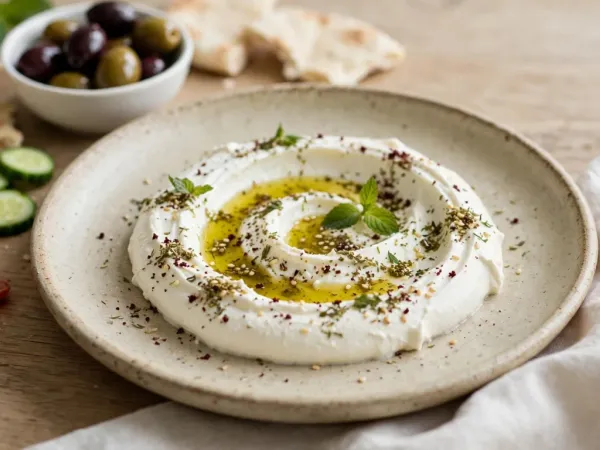
The Arabic site Mawdoo3 notes that families often make the tray in the first days of Ramadan, beside lentil soup. A Turkish mercimek çorbası is close to that soup. For a full Lebanese table, add labneh and a dish of mujadara.
Storing and safety
Cook it through
The shell is raw minced meat until it bakes. The UK’s Food Standards Agency explains why that matters: mincing moves bacteria from the surface of the meat all the way through it. USDA’s mark for ground meat is 160°F (71°C). Check it with a thermometer in a center diamond, not by the color of the edges.
Why we don’t make it raw
Kibbeh nayyeh is eaten raw in Lebanon, with lean meat pounded fine. Raw minced meat can carry Salmonella and E. coli. A 2019 study from the Lebanese University found antibodies to the parasite Toxoplasma in 42% of sheep and 34% of goats tested in North Lebanon. Its authors name raw or undercooked meat as a main route to people. This tray is fully baked.
Allergens
Bulgur is wheat, so this dish contains gluten. Pine nuts count as a tree nut on US labels, though they are not on the EU’s list of nuts. Butter or ghee on top adds milk. Walnut versions add another tree nut.
Leftovers and freezing
Leftovers belong in the fridge no more than two hours after baking. Britain’s food regulator says to eat them within 48 hours or freeze them. Reheat slices to 165°F (74°C).
Lebanese cooks often freeze the whole tray unbaked. “Never add the oil to the kibbeh tray before freezing it,” The Matbakh says. Use it within 3 months, and thaw it in the fridge. Baked straight from the freezer, a meat dish needs roughly 50% more oven time, by USDA’s reckoning. Check for 160°F (71°C) in the center.
Nutrition
A slice, one eighth of the tray, comes to about 401 calories: 26 g protein, 21 g fat, 28.5 g carbohydrate, 4.8 g fiber and 655 mg sodium. Our sums use USDA FoodData Central values, lean beef in both layers and every drop of the olive oil. Made with lamb, a serving comes to about 486 calories and 32 g of fat.
Fixes for a dry or crumbly tray
- The paste cracks when you spread it: it is too dry. Work in another tablespoon of ice water.
- It is sticky and soft: the bulgur was too wet. Chill the paste for 20 minutes.
- The tray is dry: the layers were too thick or it baked too long. Go thinner and start checking at 30 minutes.
- The top didn’t brown: there was too little fat on top, or the oven was too low. Add a little more oil and bake higher in the oven for the last 5 minutes.
- Pieces fall apart when cut: you cut too soon. Let the tray rest 10 minutes.
Substitutes
- Lamb: lean beef, or a mix of the two.
- Fine bulgur: no good swap. With coarse bulgur the texture won’t be as smooth, Zaatar and Zaytoun warns.
- Pine nuts: walnuts or almonds, as several recipes use.
- Seven-spice: allspice with a pinch of cinnamon.
Frequently asked questions
What does kibbeh bil saniyeh mean?
It means kibbeh in a tray. Saniyeh is the round metal tray it bakes in, also spelled sanieh or sayniyeh.
Is kibbeh Lebanese or Syrian?
Both claim it, and it is cooked across the Levant. Sarkis’s 1885 Beirut cookbook already had 15 kinds.
Can I make baked kibbeh ahead?
Yes. Assemble the tray, cover it well and freeze it unbaked, without the oil. Add the oil when it goes in the oven.
Why is my baked kibbeh dry?
The shell was too thick or the tray baked too long. Keep each layer about ⅓ inch (1 cm) thick.
Can I use coarse bulgur?
Recipes say no. Hungry Paprikas says coarse bulgur will not work, and Zaatar and Zaytoun says the shell won’t be as smooth.
Is kibbeh nayyeh safe to eat?
It is raw meat, so it carries the risks of any raw minced meat. Health agencies say to cook minced meat through, so we only give the baked version.
Tags: Lebanesebulgurlambbeefpine nutsbakedmake aheadfreezer friendlyIndependence Day