The Sunday Potthesundaypot.com/recipes/japanese-curry-rice/
Japanese Curry Rice: Kare Raisu with a Homemade Roux
By The Sunday Pot Kitchen Updated
- • Cook 2 onions slowly for 20 to 25 minutes, until deep amber
- • Simmer 14 oz (400 g) of beef chuck in 3⅓ cups (800 ml) of water for about 1½ hours
- • Make the roux with 3 tablespoons each of butter and flour, cooked to a nutty brown
- • Add the roux with the heat off, then simmer 5 to 10 minutes to thicken
- • Serve the curry beside short-grain rice, never poured all over it
Ingredients
4 servingsInstructions
Japanese curry rice, or karē raisu, is a mild, thick curry of beef, onion, carrot and potato served beside short-grain rice. It tastes more like a rich, gently spiced gravy than an Indian or Thai curry. This version makes the roux from scratch with butter, flour and curry powder. It serves 4 and takes about 2½ hours, mostly simmering.
What Japanese curry rice is
A gravy, not a sauce of spices
Japanese curry rice is part of yōshoku, the family of Western-inspired dishes Japan adopted from the late 1800s. The Guardian’s Felicity Cloake calls the sauce “more like a gravy thickened with a roux”. That roux of flour, fat and curry powder gives the dish its glossy, spoonable body.
It is a home dish first. Japanese dictionaries note that home cooks usually make it with store-bought roux blocks. Chefs and cookbooks often make the roux by hand, as we do here.
How it is served
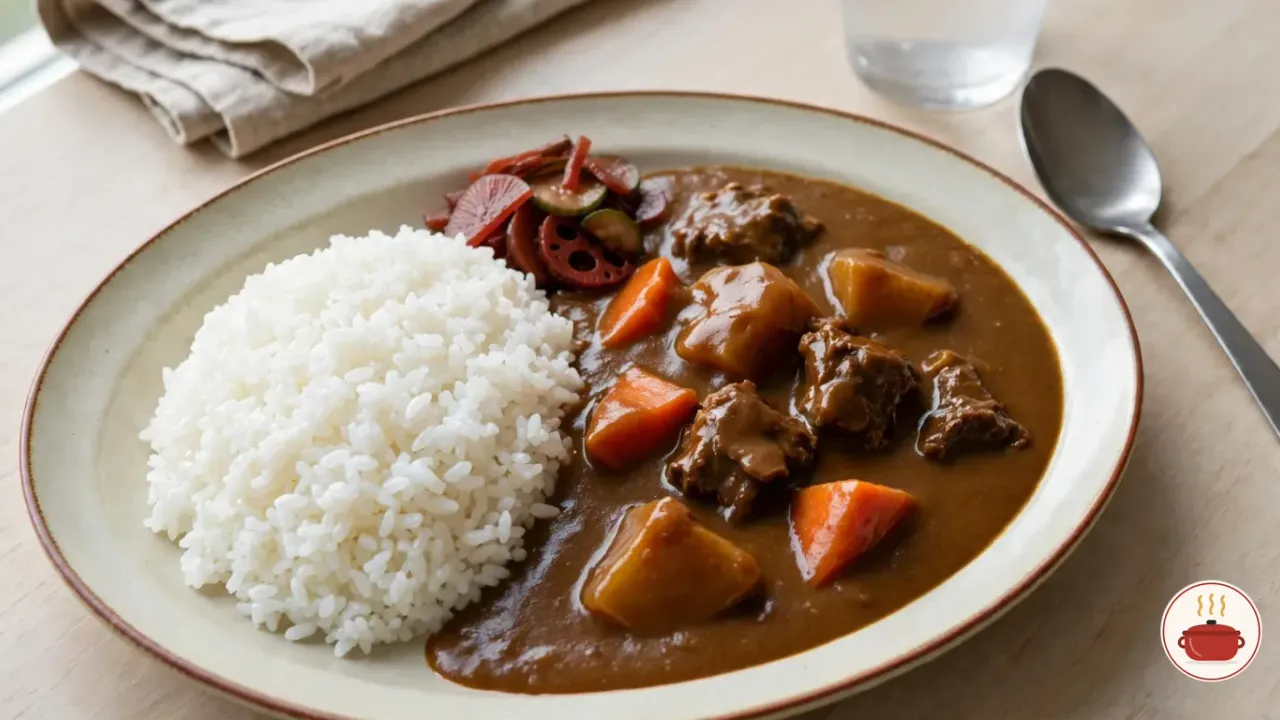
The rice goes on one half of the plate and the curry on the other. “Serve the cooked Japanese short-grain rice on one half of individual plates,” writes Namiko Chen of Just One Cookbook. Red fukujinzuke pickles or pickled rakkyō shallots sit on the side.
Where Japanese curry rice comes from
Two cookbooks in 1872
Curry reached Japan on British ships after its ports opened in 1859. That is the common view, says Japan’s Nipponica encyclopedia. In 1872, two Western-cooking books printed curry recipes: Seiyō Ryōri Shinan, now in the National Diet Library, and Kanagaki Robun’s Seiyō Ryōritsū.
Robun’s book drew on the notebook of an Englishman in Yokohama. One of its recipes, for curried veal or fowl, serves the stew with rice. A British Library curator, Hamish Todd, asked in 2015 whether it was “perhaps the first true ‘curry rice’ recipe?”. The Shinan’s curry even lists frog meat, according to Kōdansha’s science imprint Blue Backs.
For decades the dish was called raisu karē, rice curry. The name karē raisu only became the usual one after the Second World War, says the Nihon Kokugo Daijiten dictionary.
The navy’s curry
In 1908 the Imperial Japanese Navy put curry into its official cookery manual. Yokosuka City summarizes the recipe. It fries flour in beef fat, adds curry powder, stock, meat, carrot, onion and potato, and serves it over rice with chutney. That is very close to today’s pot. Yokosuka now serves a reconstruction of the 1908 recipe, with a salad and a glass of milk as its basic rule.
Two navy stories need care. The surgeon Takaki Kanehiro did fight beriberi in the navy, with barley, bread and more meat; the encyclopedia entries on him never mention curry. The famous Friday curry also started as a weekend meal. The Japan Maritime Self-Defense Force says it moved to Friday after the five-day week came in. The idea that it helps sailors keep track of the days came later.
From powder to boxes
Japanese firms began making curry powder in the early 1900s. Solid roux blocks spread after the Second World War. Japan’s government says a roux “shaped like a chocolate bar” arrived in 1950 in its Highlighting Japan magazine. S&B, by its own account, launched a solid curry in 1954. House Foods sold its first roux block in 1960, then the mild Vermont Curry in 1963, aimed at children. Each firm tells its own history, and the “first” is disputed.
Curry Day and school lunches
Japan marks Curry Day on January 22. The All Japan Curry Industry Cooperative chose it in memory of January 22, 1982, when school dietitians across the country asked schools to serve curry for lunch.
Japanese curry rice this autumn
Named in a 2027 forecast
On October 14, 2026, Whole Foods Market named “The Yōshoku Effect” among its food trends for 2027. “From pillowy milk bread to savory-sweet curry, Japanese comfort food is gaining momentum in the U.S.,” the retailer wrote. It lists Japanese curry rice among the dishes, and warm curry bread too. It adds that yōshoku is moving “to grocery aisles” through pantry staples and condiments. It is a grocer’s forecast, with no sales figures behind it.
A cheaper plate in Japan
In Japan, the plate is getting cheaper this autumn. The research firm Teikoku Databank prices a home-cooked plate of curry rice each month, from the cost of the ingredients and energy. For August 2026 it came to 348 yen, with a beef curry at 459 yen, its report says. Its index stood at 135.9 against 2020, still close to its record. For September the firm expects about 342 yen, the first drop on a year earlier after a long run of rises.
Rice is the reason. In the week of October 19 to 25, 2026, rice in Japanese supermarkets averaged 2,788 yen per 5 kg, the farm ministry MAFF reports. That is 33.7% less than a year before.
Onions down, beef up
The Statistics Bureau’s September 2026 consumer prices tell the same story, by our own sums from its item indices. Rice was 20.6% cheaper than a year before, onions 15.4% and carrots 17.0%. Domestic beef cost 6.5% more, flour 5.9% more and butter 3.2% more. Curry rice eaten out rose 3.5%.
Those are Japanese prices, not prices where you live. How much curry rice people eat or cook in 2026 has not been counted anywhere we could find.
What 32 Japanese curry recipes agree on
We read 32 Japanese curry recipes in full. Twenty-two are Japanese-language pages from Japan: five from NHK’s cooking show Kyō no Ryōri, and others from House Foods, S&B, Kikkoman, Ajinomoto, Delish Kitchen, Lettuce Club, Kurashiru and macaroni. Ten are in English, most by Japanese or Japan-based cooks, such as Just One Cookbook and No Recipes.
Onion always, then carrot and potato
Onion is in all 32. Carrot is in 24 and potato in 22, and every recipe with potato also has carrot. Beef is the usual meat, in 17 recipes, ahead of chicken in 8 and pork in 7. For 4 plates, the median is 337 g of meat, 300 g of onion and about 690 ml of liquid. Garlic appears in 20 recipes and ginger in 17.
Beef buying itself leans west. Households in Kyoto spend 36,081 yen a year on beef, against 10,176 yen in Niigata, where pork leads, the Statistics Bureau’s 2023 to 2025 survey shows.
Box or scratch
Seventeen recipes use boxed roux, 12 make a roux from flour and fat, and 3 use no flour at all. The food companies use their blocks; NHK’s chefs mostly don’t. “Even without store-bought roux, you can make the best curry,” writes the chef Doi Yoshiharu on Kyō no Ryōri, in Japanese.
Whatever the roux, it goes in last, with the heat turned off. House and S&B word that step almost the same way. A Japanese household buys about 1,200 g of roux a year, the Statistics Bureau found.
Onions: soft or amber
Fifteen recipes cook the onions until soft and 15 until brown. Those that state a time for amber onions take a median of 24 minutes. Three go further and stir in caramel. The chef Sakata Akiko says that small extra step gives “the taste of curry that has rested overnight”, in Japanese.
A secret something
Twenty-five recipes add a sweet or savory booster. Apple leads the sweet side (9 recipes), ahead of honey (4). Worcestershire sauce leads the savory side (10), then soy sauce (8) and ketchup (7). “If you use just the boxed curry roux, your curry will always taste the same,” Namiko Chen’s mother told her. Six finish with garam masala.
Tips for glossy, deep-flavored Japanese curry
- Take the onions slowly. Amber onions give the curry its sweet, deep base.
- Watch the roux. Stir it all the time over low heat; burnt flour or curry powder turns bitter.
- Add the roux off the heat. Loosen it with broth first, so it melts in without lumps.
- Add honey early, if you use it. Just One Cookbook warns that honey added after the roux “will become watery”.
- Stir the bottom. Once thick, the curry catches easily.
- Salt at the end. A homemade roux has no salt, unlike the blocks.
Serving Japanese curry rice
Spoon a mound of hot short-grain rice onto one side of a wide plate and ladle the curry beside it. Add fukujinzuke or rakkyō, a spoon and a glass of cold water. A breaded pork cutlet on top makes katsu curry.
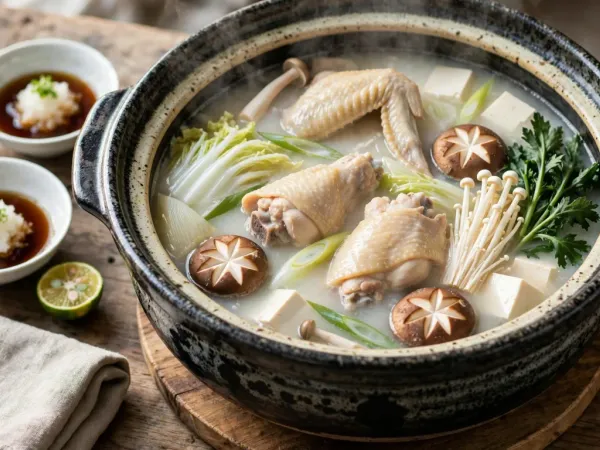
For more Japanese home cooking, try omurice, another yōshoku classic, or the chicken hot pot mizutaki on a cold night. Finish with a hojicha latte.
Safety, storing and nutrition
Day-two curry, done safely
Many Japanese cooks say curry tastes better the next day. “It’s good eaten right away, but it gets even better if you let it rest overnight,” writes the cook Kurihara Harumi on Kyō no Ryōri. Japan’s health officials add a warning.
Big pots of curry and stew are a classic source of Clostridium perfringens food poisoning. Its spores survive cooking and multiply while a large pot cools slowly at room temperature. The Tokyo Metropolitan Government’s food safety advice is to divide leftovers into small containers and chill them fast. Before eating, reheat until it bubbles, stirring well.
Leftovers
The USDA says to get leftovers into the fridge within 2 hours, in shallow containers, and to eat them within 3 to 4 days. Bring sauces and soups back to a rolling boil. The cold curry sets into a paste, so stir in about ½ cup (120 ml) of water before reheating it gently, as Just One Cookbook suggests.
Rice
Cooked rice can carry spores of Bacillus cereus. Food Standards Scotland advises chilling leftover rice within an hour, ideally, and eating it inside 24 hours. “Never reheat rice more than once,” its storage advice says.
Allergens
This curry contains wheat (in the flour, soy sauce and some Worcestershire sauces) and milk (in the butter). Soy sauce also contains soy. For a gluten-free curry, thicken it with cornstarch or potato starch instead of flour, as Felicity Cloake does, and check the labels of your sauces. Boxed roux is not vegetarian: House’s Vermont Curry, for one, is made with beef tallow and lard and lists pork and chicken among its allergens.
Nutrition
A plate with 200 g of rice has about 690 calories, with 31 g of protein, 20 g of fat, 97 g of carbohydrate and 7 g of fiber. These figures are our sums from the USDA’s data for raw chuck, onion, carrot, potato, butter, flour, curry powder and cooked short-grain rice. The salt, soy sauce and Worcestershire sauce supply most of the 860 mg of sodium. A boxed roux adds more: the curry industry’s own cooperative puts its salt content at about 10%.
Fixes for thin, lumpy or bitter Japanese curry
- It is too thin: simmer it uncovered for a few more minutes, stirring.
- It is too thick: stir in a little hot water.
- It is lumpy: the roux went into a boiling pot. Whisk well, or press the lumps through a sieve.
- It tastes bitter: the roux or curry powder burned. Add a little more grated apple or honey and some ketchup.
- It tastes flat: add salt first, then a dash more Worcestershire or soy sauce.
- The bottom caught: don’t scrape it; pour the curry into a clean pot.
Substitutes for missing ingredients
- Beef chuck: thinly sliced beef or pork, simmered for only 20 to 25 minutes, as many Japanese recipes do.
- Homemade roux: about 3½ oz (100 g) of boxed roux, half a box, for the same pot. Add it off the heat and skip the salt.
- Japanese curry powder: any mild curry powder.
- Apple: 1 teaspoon of honey, added with the water.
- Worcestershire sauce: tonkatsu sauce, or more ketchup and soy sauce.
Frequently asked questions
Is Japanese curry spicy?
Usually not. Home curry is mild and a little sweet. Roux blocks are sold in several heat levels, from mild to hot.
Why is Japanese curry so thick?
The roux. Flour cooked in butter thickens the broth into a glossy gravy.
Can I make Japanese curry with chicken or pork?
Yes. Chicken thighs or pork shoulder need about 20 to 30 minutes of simmering, not 1½ hours.
Can I freeze Japanese curry?
Yes, for about a month. Just One Cookbook suggests taking out the potatoes first, because their texture changes in the freezer.
Do you pour Japanese curry over the rice?
Not all over it. In Japan the rice usually sits on one half of the plate and the curry on the other.