The Sunday Potthesundaypot.com/recipes/hong-shao-rou/
Hong Shao Rou: Glossy Chinese Red-Braised Pork Belly
By The Sunday Pot Kitchen Updated
- • Use skin-on pork belly in 1¼-inch (3 cm) cubes with layers of fat and lean
- • Blanch the pork, dry it well, then brown it to render some fat
- • Melt rock sugar in the fat to a red-amber caramel and coat the pork
- • Braise with Shaoxing wine, light and dark soy and star anise for about an hour
- • Boil it uncovered at the end until the sauce becomes a sticky glaze
Ingredients
6 servingsInstructions
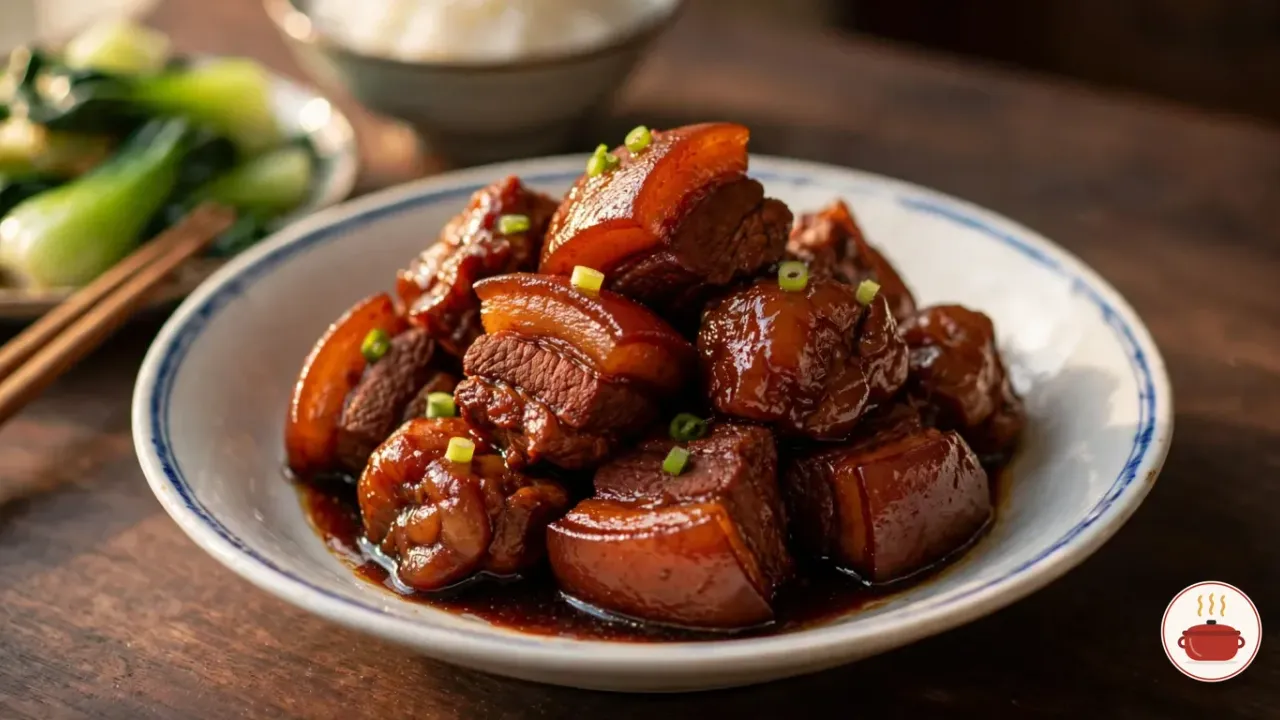
Hong shao rou is Chinese red-braised pork belly. Cubes of skin-on belly are coated in caramelized sugar, then simmered with Shaoxing wine, soy sauce and star anise. After about an hour, the sauce boils down to a glossy red glaze. This recipe feeds 6 with rice. Allow 2 hours, though the pot simmers on its own for most of that time.
What hong shao rou is
Red cooking
Hong shao means “red cooked”. It describes a family of Chinese braises in soy sauce, sugar and rice wine, which turn meat a deep reddish brown. An early 20th-century Chinese encyclopedia of customs lists red-cooked chicken, duck, pork and lamb as everyday home dishes. Pork belly is the classic.
“The authentic red braised pork always uses skin-on pork belly,” writes the cookbook author Maggie Zhu at Omnivore’s Cookbook. Chinese recipes ask for belly with three layers or more, fat and lean in stripes. The skin turns soft and sticky, and the fat turns tender.
A dish for the whole table
It is a home dish and a banquet dish, served in a bowl in the middle of the table with rice. It is a fixture at Chinese New Year. One CCTV food piece in 2017 called it a dish “you can’t do without” at the festival (our translation).
Where hong shao rou comes from
A poem about slow pork
Many Chinese articles trace the dish to the poet Su Dongpo, in the 11th century. His short Ode to Pork is real. It tells you to wash the pot, add little water and keep the fire low. “Let it cook itself, don’t hurry it,” he writes, and when the heat has done its work, it is delicious (our translation).
But the poem names no dish. Later writers linked it to Dongpo pork, a Hangzhou dish of large squares braised in wine and soy. That is a cousin of hong shao rou, not its birth.
Red as glazed tile
The clearest early recipe we could read is from Yuan Mei’s Suiyuan Shidan, a food book from 1792. His “red-simmered pork, three ways” braises the meat in wine with sweet bean paste, with soy, or with neither. All three, he writes, come out “red as glazed tile”. He also adds one blunt rule: do not fry sugar for color. You can read it in the Wikisource text (our translation).
That is the opposite of what most cooks now do. Fourteen of the recipes we compared fry sugar for color.
The name itself shows up in print by the late 19th century. In Huifang Lu, a novel whose preface is dated 1878, a character picks up “a square of red-braised pork” at a meal. That is the earliest use we could read, not proof that it is the first.
Chairman Mao’s pork
In Hunan, the dish is tied to Mao Zedong, who was born there. “Mao Zedong loved it, and insisted his Hunanese chefs cook it for him in Beijing,” says a 2007 NPR recipe feature. In Mao’s home village, Shaoshan, his nephew told the writer it helps men “build their brains”. Treat that as a local joke, not history.
Mao’s chef, Cheng Ruming, later recalled that Mao ate no soy sauce at all. So Cheng colored his red-braised pork with sugar fried in oil, according to a 2013 China News Service report. Still, many Hunan restaurants that sell “Mao-style” pork do use soy, the same report notes.
Why hong shao rou is worth making now
Pork in China costs less this year
In September 2026, pork in China cost 10.0% less than in September 2025, says the National Bureau of Statistics. The bureau published them on October 14. Prices did rise 1.2% from August. Over the first nine months of the year, pork averaged 12.9% cheaper than in 2025.
The latest weekly figures tell the same story. In the week of October 19 to 25, wholesale pork averaged 15.70 yuan per kilo, 12.1% below a year before. The agriculture ministry published them on October 26.
Fewer sows on purpose
China is shrinking its pig herd. In May 2026, the agriculture ministry cut its target for breeding sows to about 37.5 million, the first cut since February 2024, Xinhua reported. By the end of September, the herd stood at 36.02 million, down 10.7% from a year earlier, the statistics bureau said on October 20.
In an August report, the US Department of Agriculture forecast that China’s pork output will slip in 2027, from 59.68 to 58.35 million tonnes. These prices are for China. They tell you nothing about the price of pork belly in your own shop.
Two holidays ahead
Dongzhi, the winter solstice festival, falls on December 22, 2026. Lunar New Year 2027 is on Saturday, February 6, says the Hong Kong government. Both are big family meals, and red-braised pork is a New Year classic.
Nobody has published a 2026 figure for hong shao rou itself, and no 2027 trend forecast we read names it. Its news is the price of pork, not a craze.
What 27 hong shao rou recipes agree on
Our comparison covers 27 recipes, each read from start to finish. Fourteen are in Chinese, from The Paper’s Shanghai food channel, CCTV and Xiachufang, China’s big recipe site. The other 13 are in English, from Fuchsia Dunlop, The Woks of Life, Red House Spice, Omnivore’s Cookbook, NPR and others.
Blanch, then brown
Twenty-two of the 27 blanch the pork first, to clean it and firm it up. Twenty-three fry or sear it before the braise. Of the 10 recipes that say whether to keep the skin, 9 keep it on.
Rock sugar for shine
Nineteen use rock sugar, the pale lumps sold in Chinese shops. Seven use white sugar. Rock sugar gives the pork more gloss, a chef told The Paper. The median is about 1 oz (30 g) of sugar per pound (500 g) of pork, and the Chinese recipes use more. Two Chinese sources quote an old rule of thumb: one liang of sugar to one jin of meat, about 50 g per 500 g.
Wine, soy and star anise
Shaoxing or another Chinese rice wine is in 22 of the 25 recipes that list liquids. Dark soy sauce is in 20 of 25, light soy in only 15 of 24. Star anise is in 21 of the 27. Cassia or cinnamon is in 14, and bay leaves in 8.
About an hour, then a glaze
The median braise is 60 minutes. Twenty-three of the 24 recipes that say either way finish by boiling the sauce down, uncovered, until it coats the pork. “We’re not serving the sauce with the pork – this ain’t hongshao soup,” write the authors of Chinese Cooking Demystified.
The big split: sugar color or soy color
Fourteen recipes melt the sugar in oil first, the technique Chinese cooks call chao tang se, frying the sugar color. Eleven just add sugar to the liquid with soy. Some Chinese home cooks prefer the second way, because burnt caramel is easy to get wrong.
This recipe uses the caramel and both soy sauces, the most common mix. If you are nervous about caramel, skip step 4 and add the sugar with the water. The pork will be a little less shiny.
Shanghai style or Hunan style
Shanghai: dark and sweet
Shanghai cooks make it darker and sweeter, colored mostly with dark soy and with few spices or none. Fuchsia Dunlop’s book Land of Fish and Rice covers this region. In Shanghai, “they like theirs dark, sleek and seductively sweet,” she writes in a recipe reprinted by Matching Food & Wine. Hard-boiled eggs often braise alongside. Red House Spice notes that dark soy plays a key role in coloring the pork there. In Wuxi, nearby, it gets sweeter still.
Hunan: caramel and chile
Hunan versions take their color from caramel and use little or no soy. They add dried chiles, cassia and star anise. Dunlop’s Mao-style recipe for SBS Food uses just 1 teaspoon of soy for about 3¼ lb (1.5 kg) of pork. For a Hunan pot, leave out the dark soy, add the chiles and salt it to taste.
Tips for tender, glossy pork
- Buy good belly. Look for even stripes of fat and lean, with the skin on.
- Dry the pork well. Water on the meat makes hot sugar and fat spit.
- Add hot water, not cold. Several Chinese recipes warn that cold water tightens the meat.
- Keep the simmer low. A hard boil makes the lean dry and stringy.
- Make it a day ahead. Dunlop chills it overnight, lifts off the white fat, then reheats and reduces it.
- Watch the end. The glaze goes from glossy to burnt in a minute.
Serving hong shao rou
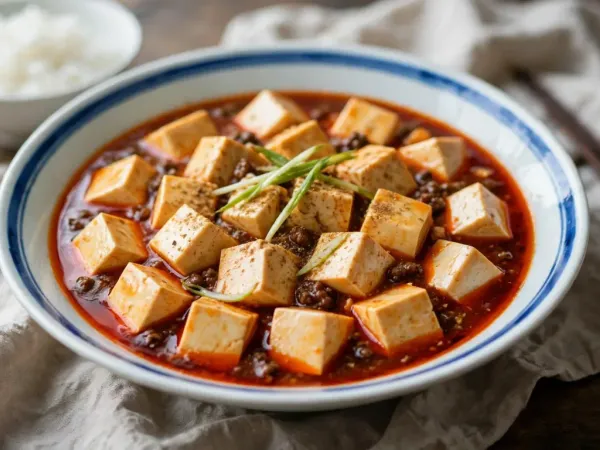
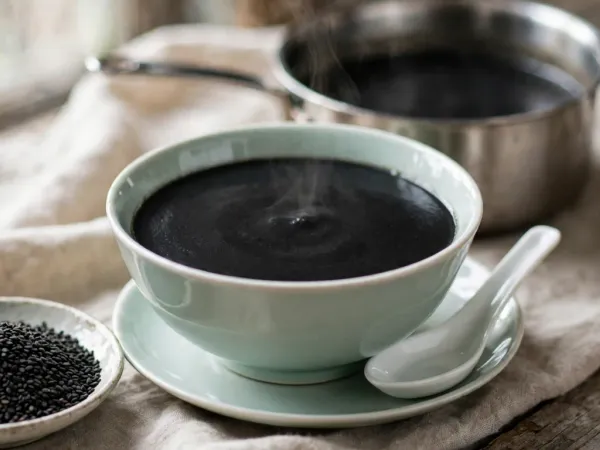
Serve it in a shallow bowl in the middle of the table, with white rice and something green and plain, such as stir-fried bok choy. One bowl is rich, so a little goes a long way. For a bigger spread, add Sichuan mapo tofu, and finish with warm black sesame soup.
Other sweet and savory braises from Asia work the same way. Try Filipino chicken adobo with soy and vinegar, or Indonesian tempe bacem with palm sugar.
Safety, storing and nutrition
Cook it through
The USDA’s safe temperature chart puts whole cuts of pork at 145°F (63°C) with a 3-minute rest. An hour of simmering goes far past that. Here the clock is set by tenderness, not safety.
Hot sugar
Melted sugar clings to skin and burns deep. Keep children away from the wok and lower the pork in gently. For a burn, the NHS says to run cool water over it for a full 20 minutes.
Allergens and salt
Soy sauce contains soy and usually wheat, both named as major allergens by the FDA. For a gluten-free pot, use tamari and check that your rice wine contains no wheat. One serving has about 640 mg of sodium before any added salt. That is our estimate from USDA values, and dark soy is less salty than the shoyu we counted.
Storing
Chill the pot within two hours of cooking. Britain’s Food Standards Agency gives leftovers 48 hours in the fridge, or you can freeze them, and it warns against reheating more than once. Reheat it until steaming hot all the way through. The chilled fat sets on top, so you can lift it off before you reheat.
Nutrition
A plate of pork without eggs or rice, one of six, has up to about 770 calories. It has about 17 g of protein, 72 g of fat and 11 g of carbohydrate. These are our sums, built on USDA data for raw pork belly, soy sauce and sugar, with sake standing in for Shaoxing wine. It assumes you pour off some of the fat; skim the chilled fat and the real figure drops.
Fixes for tough, pale or bitter pork
- The pork is tough: it needs more time. Add a splash of hot water and simmer longer.
- The color is pale: add 1 to 2 teaspoons more dark soy while the sauce reduces.
- It tastes bitter: the caramel went too dark. Next time stop at red-amber.
- The sauce won’t thicken: keep boiling it uncovered. The sugar and gelatin will turn it sticky.
- It is greasy: spoon off the fat before you reduce, or chill it and lift the fat off.
- It tastes too salty: stir in hot water and a pinch of sugar, then boil it down again.
Substitutes for missing ingredients
- Rock sugar: white sugar or light brown sugar.
- Shaoxing wine: dry sherry.
- Dark soy sauce: more light soy and an extra teaspoon of sugar. The color will be lighter.
- Cassia: a cinnamon stick.
- Skin-on belly: skinless belly works, but you lose the soft, sticky skin.
Frequently asked questions
What does the name hong shao rou mean?
“Red-cooked meat”. Hong is red, shao is to cook or braise, and rou means meat, usually pork.
How is hong shao rou different from Dongpo pork?
Dongpo pork, from Hangzhou, uses big squares, often tied with string, braised in wine and soy. Hong shao rou uses bite-size cubes.
Is hong shao rou the same as char siu?
No. Char siu is roasted barbecue pork. Hong shao rou is braised in a pot.
Do I have to caramelize the sugar?
No. Many Shanghai cooks get the color from dark soy instead.
Can I make it ahead?
Yes. It reheats well, and chilling it makes the fat easy to remove.
What cut of pork should I buy?
Skin-on pork belly with clear layers of fat and lean.