The Sunday Potthesundaypot.com/recipes/bigos/
Bigos: Polish Hunter's Stew with Sauerkraut and Kiełbasa
By The Sunday Pot Kitchen Updated
- • Use about 2 parts sauerkraut to 1 part fresh cabbage by weight, the median of 27 recipes
- • Squeeze the sauerkraut instead of rinsing it, and rinse it only if it is very sour
- • Brown the meat in batches before the cabbage goes in
- • Cook it for about 2½ hours on day one, then chill it overnight and reheat it
- • Cool it in shallow containers within 2 hours and reheat it until it bubbles, as USDA advises
- • Salt only at the end: sauerkraut and smoked meats bring plenty
Ingredients
8 servingsInstructions
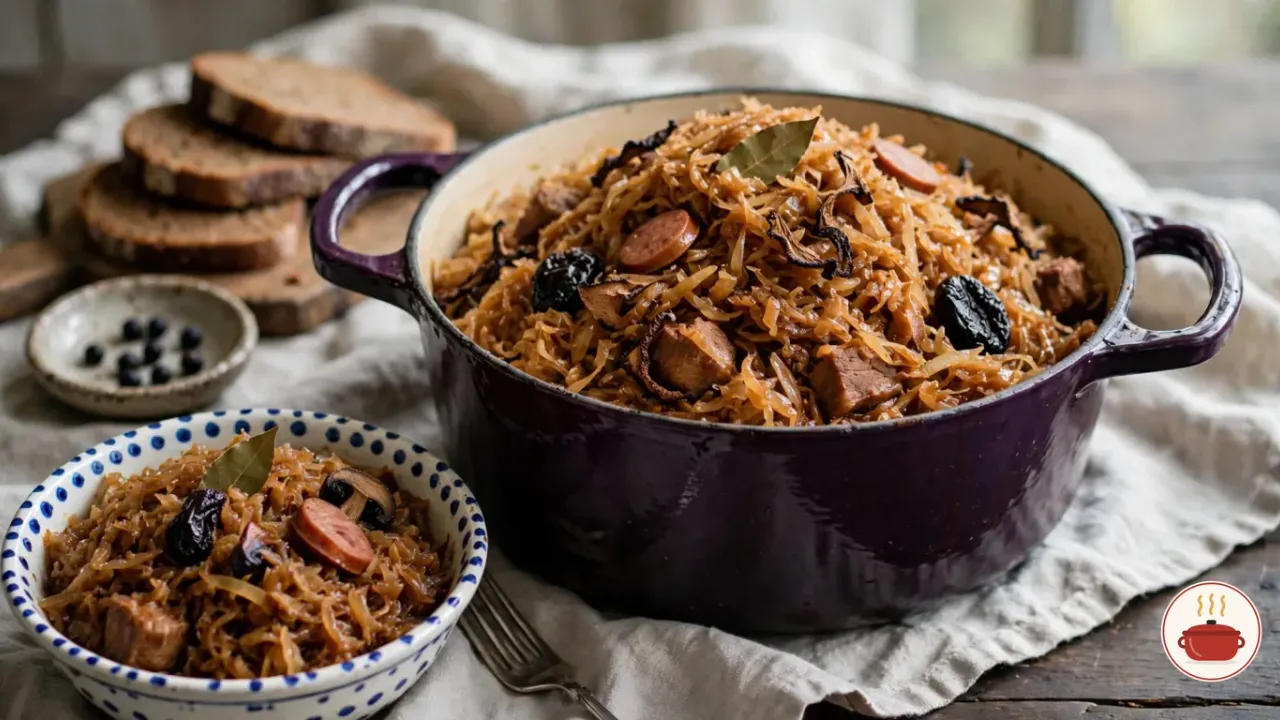
Bigos is Poland’s hunter’s stew: sauerkraut and fresh cabbage braised with pork, beef, smoked kiełbasa, dried porcini and prunes. Polish cooks make it a day ahead, because it tastes better reheated. This recipe serves 8. It takes about 3½ hours, plus a night in the fridge.
What bigos is
A word for chopping
Bigos is sour, smoky and deep brown, with more cabbage than meat. The word is older than the dish. In the 17th century, bigos meant a “chopped mess”, explains Poland’s National Centre for Culture. Old memoirs speak of men threatening to “bigos” each other with a sabre (our translation).
Where the word came from is unsettled. The linguist Aleksander Brückner traced it to the German Bleiguss, “little bits of lead”, in his 1927 dictionary. Poland’s farm ministry suggests another German word, Beiguss, meaning sauce.
A stew that once had no cabbage
The first printed Polish cookbook, from 1682, lists bigos of carp, of capon and of hazel grouse. The food historian Jarosław Dumanowski explains it for the Wilanów Palace Museum. “In this and many other 17th- and 18th-century recipes there isn’t a single piece of cabbage in the bigos!” (our translation)
Those early versions were chopped roast meat or fish, soured with lemon, vinegar or sorrel. Sour cabbage gave the same tang for far less money. By the 19th century, he writes, only the balance of meat and cabbage had to shift to reach the bigos Poles cook today.
The poet’s hunting stew
Poland’s national epic, Adam Mickiewicz’s Pan Tadeusz of 1834, stops after a bear hunt for a pot of bigos. “In words it is hard to express the wonderful taste and colour of bigos and its marvellous odour,” runs the 1917 English translation on Project Gutenberg.
The hunters then charge the kettles “armed with spoons”. A note in the same edition explains why the stew was ready. Bigos “is usually made in large quantities, put into barrels, and stored in cellars. The oftener it is heated the more savoury it is.”
On the government’s list
Poland’s agriculture ministry keeps a list of traditional products, and it holds three versions of bigos. The Lubusz hunter’s bigos entry says that eating bigos was the “beloved point” of Hubertus hunting feasts, a custom of more than 60 years (our translation). Its ingredients are sauerkraut, dried porcini, pork or game, prunes and spices.
The Greater Poland entry adds a rule every Polish cook repeats: “Kept cold and reheated, it gains in flavour” (our translation). Bigos is also on the ministry’s canon of Polish cuisine, a list of at least 100 dishes published in 2019.
Why bigos belongs on the table this fall
A big year for cabbage
In the first half of 2026, Poland imported 24,260 tonnes of white and red cabbage, worth 84.18 million złoty. That is almost the value of all of 2025’s imports, reports the trade site warzywa.pl, from national statistics office data. Most of it arrived in spring, before the home crop.
That crop is now in. Polish farmers grow cabbage on 12,753 hectares in 2026, and nearly half of it is in two regions, Małopolska and Łódź, according to warzywa.pl. On October 9, white cabbage sold for about 0.75 złoty a kilo at Warsaw’s Bronisze wholesale market, the same site found.
Bigos season in Poland
The stew is all over Poland’s autumn calendar. Lidl’s Polish recipe site published a hunter’s bigos and an Old-Polish bigos on August 21, 2026. On September 19, a village women’s club from Nasale won a distinction for its hunter’s bigos. The prize came at “Polska Smakuje”, a national cooking final run by the state farm agency KOWR.
Lubicz, near Toruń, held its first bigos festival on September 27, with a contest for the best pot, pozatorun.pl reported. St. Hubert’s Day, the hunters’ feast, falls on Tuesday, November 3. Then comes Christmas, when bigos is a favorite in many Polish homes.
No one has published a 2026 sales or search figure for bigos itself, and we found none. The signs above are about its season and its cabbage, not the dish’s sales.
The ingredients that make bigos
We compared 27 bigos recipes. Seventeen are written in Polish, from Kwestia Smaku, AniaGotuje, Moje Gotowanie, Lidl and home cooks on Smaker and DoradcaSmaku. Eight of the 10 English ones are by Polish cooks, at home or abroad. This recipe follows their medians, scaled to 8 servings.
Two cabbages, two to one
Twenty-six of the 27 use sauerkraut, and 17 mix it with fresh white cabbage. Where both are weighed, the median is 2 parts sauerkraut to 1 part fresh cabbage. Fresh cabbage softens the sourness and adds sweetness.
Buy sauerkraut made only from cabbage and salt. “It has to be properly lacto-fermented, without any vinegar added,” writes Kasia of the Polish food blog Polonist. Bagged or jarred both work. Taste it before you decide whether to rinse.
Plenty of meat
Bigos is generous with meat. The median is about 850 g of meat for every kilo of cabbage. Kiełbasa appears in 21 recipes, smoked bacon in 19, fresh pork in 17 and beef in 14. Only 2 use game, such as wild boar or venison.
Old-Polish versions go further. “A true Old-Polish bigos should be cooked from cabbage and meat in a 1:1 proportion,” says the radio station RMF FM (our translation). Leftover roast meat is welcome too.
Mushrooms, prunes and wine
Dried wild mushrooms are in 24 recipes, at a median of about 36 g per kilo of cabbage. Porcini are the usual choice. Prunes are in 20, and they balance the sour cabbage with a dark sweetness.
Some cooks insist on smoked prunes, sold in Poland as suska sechlońska. Seventeen recipes add red wine, a median of about ⅔ cup (157 ml). Tomato appears in 19, but two Polish sites leave it out on purpose. AniaGotuje notes that Old-Polish cooking didn’t know it.
The spice shelf
Black pepper is in 25 recipes, bay leaves in 23 and allspice in 20. Juniper, the classic flavor of game, is in 16. Caraway and marjoram are common extras. That’s the whole spice shelf: bigos gets its depth from smoke, mushrooms and time.
How to make bigos
Squeeze, don’t drown
Sauerkraut carries salt and sharp acid. Eleven recipes rinse it only when it is very sour, and 7 squeeze it without rinsing. “I don’t rinse the sauerkraut, I squeeze it out of its salty-sour water. For me it’s a flavour compromise,” writes Ania of AniaGotuje (our translation). Keep the juice to add back if the pot tastes flat.
Use a heavy, enameled pot
Bigos cooks for hours, and sauerkraut is acidic. AniaGotuje’s advice is to choose “an enamelled pot or enamelled cast iron, but never an aluminium pot” (our translation). A heavy pot also spreads the heat, so the cabbage browns slowly without burning.
Two and a half hours on day one
The median first-day cooking time is 150 minutes. The cabbage should end soft and caramel brown, and the meat tender enough to break with a spoon. Stir it often near the end, when the liquid runs low.
Chill it overnight
Twenty-three of the 27 recipes say to serve bigos the next day or later, or to reheat it. “That is why it’s good to make bigos the day before serving,” writes Anna Śmiałek in Beszamel, a Polish recipe site, in October 2026. She adds that bringing it to the boil again and again “for several days” is unnecessary (our translation).
The old custom of cooling the whole pot on a frosty balcony is a slow way to cool food. Divide a big pot into smaller containers “so it will cool quickly”, the USDA advises, and refrigerate it within 2 hours.
Serving and storing bigos
At the table
Serve bigos hot with dark rye bread, or with boiled potatoes sprinkled with dill. In Old-Polish homes, bigos with sausage opened the midday dinner, served before the soup, says the ministry’s Greater Poland entry. For another Polish cabbage dish, try our golumpki soup. Fans of sour, fermented stews should also meet Korean kimchi jjigae.
Keeping it
Polish cooks often keep bigos for a week, but US food safety advice is stricter. The USDA gives cooked leftovers 3 to 4 days in the fridge and 3 to 4 months in the freezer. Bigos freezes well in portions. Reheat it until it bubbles: the USDA chart lists 165°F (74°C) for leftovers.
Some Polish cooks seal hot bigos in jars and pasteurize them. We prefer the freezer, which keeps it safe for months.
Game and mushrooms
Wild boar and bear can carry trichinella worms, and “freezing wild game meats may not effectively kill all worms”, says the CDC. If you use game, add it at the start so it braises for the full time.
Buy dried mushrooms from a shop. Picking your own is risky: wild mushrooms “should be evaluated by a trained mycologist before ingestion”, the CDC warns.
Calories, salt and allergens
A serving has about 520 calories, 32 g of protein, 31 g of fat, 26 g of carbohydrate and 7 g of fiber. We totaled USDA FoodData Central values for each raw ingredient and divided the pot by 8.
Salt is the number to watch. One serving holds about 1,400 mg of sodium before squeezing, mostly from the sauerkraut and smoked meats. That is well over half of the FDA’s daily value of 2,300 mg. Squeezing the kraut lowers it.
This bigos contains none of the 9 major food allergens. Check the kiełbasa label, though: some sausages contain wheat, soy or milk.
Fixes for bigos that is too sour, too wet or bland
- Too sour: add more fresh cabbage, a few more prunes, or a spoonful of plum butter.
- Too salty: add shredded fresh cabbage and a little water, and simmer it in.
- Too wet: cook it uncovered, stirring often, until the liquid is gone.
- Burned on the bottom: don’t scrape. Move the good part to a clean pot.
- Bland: add some of the saved sauerkraut juice, more mushroom, or a pinch of marjoram.
- Tough meat: keep simmering. Pork shoulder and beef chuck need time.
- Pale cabbage: it needs longer uncovered. The color deepens on reheating.
Substitutes for missing ingredients
- Polish kiełbasa: any firm, good-quality smoked pork sausage.
- Smoked slab bacon: thick-cut smoked bacon.
- Dried porcini: other dried wild mushrooms, or 7 oz (200 g) fresh cremini, browned and added for the last 30 minutes.
- Smoked prunes: ordinary prunes, or 2 tablespoons of plum butter.
- Juniper berries: leave them out.
- Fresh cabbage: more sauerkraut, rinsed once to soften it.
- Pork shoulder or beef: venison, wild boar, duck legs or leftover roast pork.
- Red wine: stock with a teaspoon of tomato paste.
Frequently asked questions
Where does the word bigos come from?
In old Polish it meant a “chopped mess” of meat. Today it means this stew of cabbage and meats.
Why is bigos called hunter’s stew?
It was cooked in big pots for hunting parties and Hubertus feasts, and game often went in. The most famous scene is a hunt in Pan Tadeusz.
Should I rinse the sauerkraut?
Taste it first. Most Polish cooks squeeze it and rinse it only if it is very sour or salty.
Why is bigos better the next day?
Polish cooks say the flavors meld as it rests, and reheating reduces the liquid. Most recipes serve it the day after cooking.
How long does bigos keep?
Up to 4 days in the fridge, or up to 4 months in the freezer.
Can I make bigos in a slow cooker or oven?
Yes. Brown the meats first. Cook it covered at 320°F (160°C) for 3 to 4 hours, or on low in a slow cooker for 8 hours.
Is bigos gluten-free?
Usually, yes. Check the kiełbasa and bacon labels, because some contain wheat fillers.
What goes well with bigos?
Dark rye bread or boiled potatoes. It is also a Christmas-season favorite in Poland.
Tags: stewporkDutch ovenmake aheadfreezer friendlySunday dinner