The Sunday Potthesundaypot.com/recipes/polish-roast-goose/
Polish Roast Goose with Apples for St. Martin's Day
By The Sunday Pot Kitchen Updated
- • Salt the goose the night before and dry it, uncovered, in the fridge for 12 to 24 hours
- • Prick only the skin, with the fork held almost flat
- • Roast at 350°F (180°C) for about 45 minutes per kilo, the median of the 39 recipes we compared
- • Pour off the fat every 45 minutes: a 10 lb goose gives about 1 quart
- • It is done at 165°F (74°C) in the thigh, the wing and the breast
- • Rest it 30 minutes before you carve
Ingredients
8 servingsInstructions
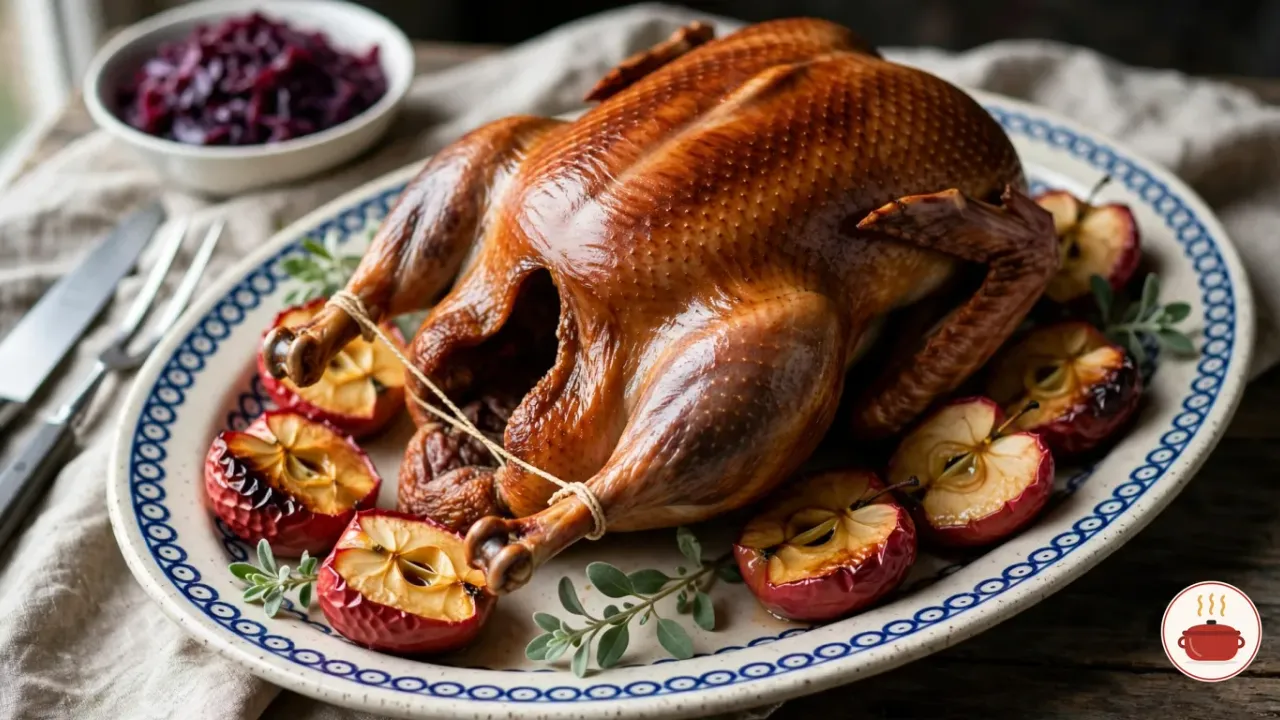
Polish roast goose, gęś pieczona z jabłkami, is the dish of St. Martin’s Day, November 11. Cooks rub the bird with salt and marjoram, fill it with tart apples and roast it until the skin crackles. A 10 lb goose feeds about eight, and it leaves a jar of fat for the winter.
What Polish roast goose is
A goose for St. Martin’s Day
“Na świętego Marcina / Bardzo dobra gęsina”, goes the rhyme: on St. Martin’s Day, goose is very good. The folklorist Karol Mátyás wrote it down in the village of Gorzyce, in his 1903 study of autumn customs in the old Sandomierz forest.
The timing is practical. Witold Wróbel of the Polish Academy of Taste told the news agency PAP in 2021 that young geese of 16 to 18 weeks taste best around November. The feast also marked the end of the year’s work in the fields and orchards, he said.
November 11 is also Poland’s Independence Day. The Adam Mickiewicz Institute’s culture.pl calls it “an occasion for a double celebration”, with goose, St. Martin’s wine and Poznań’s crescent pastry, the rogal świętomarciński.
The legend of the geese
A popular story says Martin hid in a goose pen to avoid becoming bishop of Tours, and the honking birds gave him away. Treat it as a later legend. The earliest life of the saint, by Sulpicius Severus around 397, tells a different trick: a citizen pretended his wife was ill to lure Martin out of his monastery. That text has no geese in it at all.
Apples and marjoram since the 1870s
The Polish recipe has hardly changed in 150 years. Lucyna Ćwierczakiewiczowa’s 365 obiadów, in its 1871 edition, salts the goose inside and out. She fills it with small tart apples and a sprig of marjoram, then roasts it on sliced onions. She bastes it first with water, then with its own juices.
A 1929 poultry book by “Pani Elżbieta” adds the side dishes still served today: red cabbage, lingonberries and apple sauce. The country’s list of traditional foods includes a roast goose from Ostrzeszów, in Wielkopolska, entered in 2009. Its entry describes the smell of marjoram and tart apples, or a filling of buckwheat or barley groats.
The oat-fed goose
Most Polish geese belong to one breed, the White Kołuda goose, bred at the Kołuda Wielka research station in Kujawy. The Ministry of Agriculture’s list entry explains the word owsiana, “oat-fed”. The geese get unlimited whole oats for 3 weeks before slaughter, at 15 to 16 weeks old. A dressed bird weighs 4.5 to 5.8 kg.
Why goose is in the news in Poland this fall
A fight over a protected name
Poland applied to register “polska gęś owsiana”, Polish oat-fed goose, as a protected EU name. The EU agriculture commissioner was due to announce it on June 19, 2026. On June 18, the last day for objections, Germany formally challenged the application, RMF FM reported. Feeding geese oats is not a tradition unique to Poland, the German side argued, according to RMF.
The two countries then had three months to agree, with a possible three more, the Ukrainian outlet UA.NEWS reported in July. We found no announced decision as of October 21.
Germany’s St. Martin’s goose comes from Poland
The stakes are commercial. Poland exported more than 12,000 tonnes of goose in 2025, and 8,000 tonnes went to Germany, Dariusz Goszczyński of the National Poultry Council told RMF FM. Germany eats its own Martinsgans on the same day.
One German state shows the pattern. North Rhine-Westphalia bought 657 tonnes of whole geese from Poland in 2024, more than 99% of its whole-goose imports. The figures come from the state statistics office, as reported by the farm paper top agrar.
Prices going into the season
Farmers are earning more for their geese this year. In the week of September 28 to October 4, 2026, fattened geese fetched 16.56 złoty per kilo, live weight. The figure comes from the weekly market report of the National Support Centre for Agriculture (KOWR). That was about 17% more than a year earlier, the agency says.
Bird flu, and a missing figure
Poland currently counts as free of highly pathogenic bird flu, the Chief Veterinary Officer said on October 12. The same notice warns that autumn migration sharply raises the risk. We found no report of a goose shortage.
Nobody publishes a count of the geese Polish families roast in November. No source we read gives a 2026 number for the dish itself, and no supermarket offers for St. Martin’s Day had appeared yet.
What goes into Polish roast goose
We compared 39 recipes. Twenty-six are in Polish, from Kwestia Smaku, Smaker, Moje Gotowanie, Kuchnia Lidla (two by the TV chef Karol Okrasa), and farm and radio sites. Five come from old cookbooks, from 1871 to 1929. Thirteen are in English, from BBC Good Food, Great British Chefs, Jamie Oliver, America’s Test Kitchen, Delia Smith and Polish-American cooks.
The bird
The median goose weighs 4.5 kg, with a range of 3.5 to 6 kg. Choose a young, meaty bird. “Pani Elżbieta” warned in 1929 that an over-fattened goose loses its fat in the oven, and its meat turns dry and stringy (our translation).
Apples and marjoram
Apples go into or around 27 of the 39 geese, and 21 of the 26 Polish ones. Marjoram appears in 24, and in 20 of the Polish recipes. Only four recipes add prunes, and just one fills the bird with groats.
The Polish cooks who name a variety pick tart, firm apples: szara reneta in four recipes, antonówka and boiken in two each. English recipes use Bramley or Granny Smith. Garlic turns up in 12 recipes, almost all Polish.
Salt ahead, or brine
Nineteen recipes salt or season the goose ahead, for a median of 12 hours. Six Polish ones soak it in salted water first. Okrasa leaves his in a 10% brine for 2 to 3 days.
Heat and time
The median roasting time is 45 minutes per kilo, from 30 to 101. The median main oven setting is 180°C (350°F), with a hotter spell at a median of 200°C (390°F) to brown the skin. Twenty recipes cover the goose for part of the time, often in a lidded goose roaster, the gęsiarka.
A few go very low, such as 130°C (265°F) for 7 hours. The USDA does not recommend roasting poultry below 325°F (163°C), and its chart gives a whole goose 20 to 25 minutes per pound at that heat. This recipe stays at 350°F (180°C) and lands at about 44 minutes per kilo.
How to roast a goose so the skin crisps
Dry the skin overnight
Wet skin steams instead of crisping. America’s Test Kitchen refrigerates its goose “uncovered, for 24 to 48 hours”. The chef Martin Wishart, writing for Great British Chefs, leaves his bird to dry for an hour, which “will help the skin to crisp”. The Polish habit of salting the night before does the same job.
Prick the skin, not the meat
A goose carries a thick layer of fat under the skin, and it needs a way out. Great British Chefs says to “only prick the skin and not through to the flesh”. Hold the fork almost flat against the bird, and work over the breast and thighs. The USDA’s duck and goose guide adds that the fat layer must melt away for the bird to be done.
Keep the marjoram inside
Dried herbs scorch on the skin in a long roast. One Beszamel recipe rubs marjoram only inside the cavity for that reason. Here, the herb goes inside and into the apples, and the skin gets just salt and pepper.
Pour off the fat
Rendered fat collects fast. BBC Good Food tells cooks to “carefully ladle all the fat out of the tin”, and to do it more than once. Lift the pan out of the oven, tilt it gently, and use a baster or a ladle. The fat is very hot, so work slowly.
Use a thermometer
Only one of the 39 recipes gives an internal temperature. The rest rely on clear juices or a soft drumstick. The USDA says a whole goose is safe at 165°F (74°C). Measure it in the innermost part of the thigh and wing, and in the thickest part of the breast. The meat may still look a little pink at that point.
Rest, then carve
Rest the goose for 20 to 30 minutes. It stays hot under loose foil, and the juices settle. Kwestia Smaku carves in a set order: the wings, then the legs, then the body cut in half and the breasts lifted out.
Serving Polish roast goose
At the table
Serve the goose with the roasted apples, braised red cabbage and potato dumplings, either Silesian kluski śląskie or the steamed pyzy of Wielkopolska. Potatoes fried in goose fat and lingonberry sauce are the other classics. A Poznań organizer of the city’s goose promotion put it simply to PAP: Americans have turkey, and Poles can have goose (our translation).
For a longer Polish menu, start with a bowl of golumpki soup. On the next cold weekend, the fat and any leftover meat suit a pot of bigos.
The fat
A goose of 4 to 4.5 kg gives about 1½ liters of fat, Kwestia Smaku says. Strain it into clean jars and keep them in the fridge. Great British Chefs gives it 2 to 3 months in a sterilized jar, or 6 months in the freezer. That is a cook’s guide, not an official limit.
Use it for roast potatoes, or make smalec, Polish lard for bread. Ćwierczakiewiczowa fried the fat with onion, apple and marjoram, then strained it.
The giblets
The neck, wings, liver and gizzard make a good stock. A 1912 Polish cookbook simmered them into a soup or a stew with sour cream and pearl barley.
Safety, storage and allergens
Thawing a frozen goose
A frozen goose takes 1 to 2 days or more to thaw in the fridge, the USDA says. In cold water, it takes 4 to 6 hours, with the water changed every 30 minutes. Never thaw it on the counter, even though some Polish recipe sites suggest it.
The apples inside
The USDA advises cooking any stuffing separately for even doneness. If you fill the bird, spoon the filling in loosely and bring its center to 165°F (74°C). This recipe uses only apples, onion and marjoram, which leave the cavity open for heat. Check them with the thermometer too, and refrigerate the leftovers within 2 hours.
Leftovers
Cooked goose keeps for 3 to 4 days in the fridge, or 2 to 3 months in the freezer, according to the same USDA page. Never brown a goose partway and finish it later: cook it in one go. Reheat leftovers to 165°F (74°C).
Calories and allergens
One serving of goose with its skin and apples comes to about 800 calories, with 59 g of protein and 51 g of fat. Without the skin, the meat alone is closer to 420 calories. We built the estimate from USDA FoodData Central data on roast goose and its yield, plus the apples and onions, divided by 8. The sodium counts all the salt, though some runs off with the fat.
The recipe contains none of the nine major food allergens on the FDA’s list, and no gluten. Bread stuffings, butter and flour gravies would add wheat or milk.
Fixes for goose that is greasy, pale or tough
- Greasy skin: the fat had no way out. Prick the skin more closely next time, and pour off the fat more often.
- Pale, soft skin: the skin was wet, or the foil stayed on too long. Dry the bird overnight, and give the last 20 minutes at 425°F (220°C).
- Dark spots on the breast: the oven runs hot at the top. Cover those spots with a piece of foil.
- Tough, dry meat: the goose was old, or it roasted too long. Choose a young bird, and start checking the temperature after 2½ hours.
- Smoke from the oven: fat pooled in the pan and burned. Keep the water under the rack, and ladle the fat off on time.
- Bitter pan juices: the marjoram burned on the skin. Keep it inside the bird.
Substitutes for hard-to-find ingredients
- Szara reneta or antonówka apples: Bramley, Granny Smith or another tart, firm apple.
- Dried marjoram: fresh marjoram, about 3 tablespoons, or dried thyme, which tastes different but works.
- A whole fresh goose: a frozen one, thawed in the fridge. Or roast two ducks of 4 to 6 lb (1.8 to 2.7 kg), unstuffed: the USDA gives them 30 to 35 minutes per pound at 350°F (180°C).
- A roasting rack: a bed of thickly sliced onions and carrots.
- Cheesecloth for the fat: a coffee filter or a paper towel in the sieve.
Frequently asked questions
Why do Poles eat goose on St. Martin’s Day?
Young geese are at their best in November, and the feast once closed the farming year. The rhyme “on St. Martin’s Day, goose is very good” was recorded in 1903.
How long does it take to roast a goose?
About 45 minutes per kilo, or 20 minutes per pound, at 350°F (180°C). A 10 lb (4.5 kg) goose needs about 3 hours 20 minutes, plus 30 minutes of rest.
What temperature should goose be cooked to?
165°F (74°C) in the inner thigh, the wing and the thickest part of the breast, according to the USDA.
Should you cover a goose when roasting?
For most of the time, yes, if you want moist meat: foil keeps the breast from drying while the fat renders. Take it off for the last hour so the skin crisps.
Which apples are best for roast goose?
Tart, firm ones that hold their shape. Polish cooks prefer szara reneta or antonówka. Bramley and Granny Smith work well.
How much fat does a goose give?
About 1 to 1½ liters from a 9 to 10 lb (4 to 4.5 kg) bird. Strain it and keep it in the fridge for roast potatoes.
How many people does a 10 lb goose feed?
About 6 to 8. A goose has a big frame: USDA figures put the roast meat and skin at about 41% of the raw weight.
Can I stuff a goose with bread stuffing?
You can, but the USDA advises cooking stuffing separately. If you fill the bird, pack it loosely and check that the center reaches 165°F (74°C).