The Sunday Potthesundaypot.com/recipes/rogal-swietomarcinski/
Rogal Świętomarciński: Poznań's St. Martin's Croissant
By The Sunday Pot Kitchen Updated
- • Simmer white poppy seeds for 30 minutes, drain and grind them 2 or 3 times
- • Cook them with butter, sugar, nuts and dried fruit, then add crumbs and an egg
- • Grate cold butter over a yeast dough and give it 3 letter folds, chilling in between
- • Roll filled triangles into fat crescents and bake at 350°F (180°C) for 25 to 30 minutes
- • Spread white icing over the warm croissants and press on chopped almonds
Ingredients
8 large croissantsInstructions
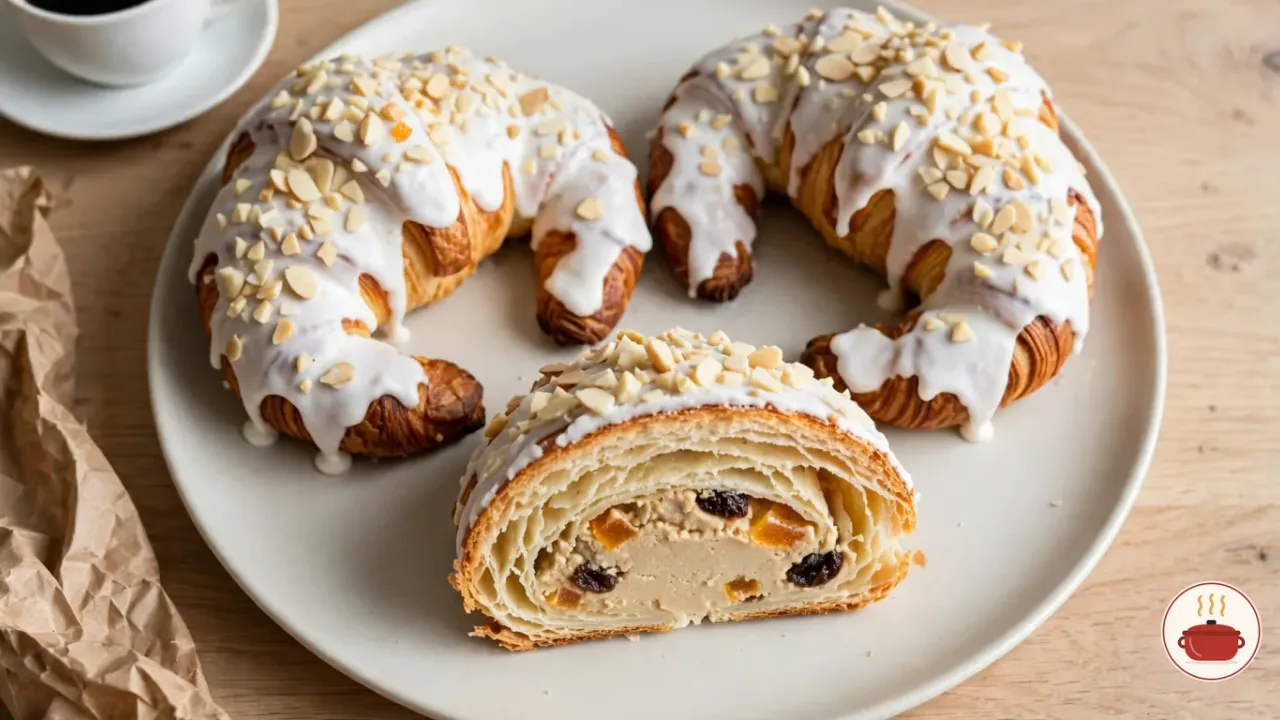
Rogal świętomarciński is the St. Martin’s croissant of Poznań, in western Poland. It is a large, flaky crescent of layered yeast dough, filled with white poppy seed, nuts and dried fruit, then iced and topped with nuts. Poznań eats it on November 11. This recipe makes 8; plan on 3 hours of work plus a long chill.
What rogal świętomarciński is
A protected pastry
Since 2008, the name has been a protected geographical indication in the European Union. The rules say what a baker must do to sell a pastry under it. According to the EU’s product description, it is “crescent-shaped, coated with icing and sprinkled with chopped nuts”. It weighs 150 to 250 g, and the filling is “creamy brown”.
The filling is mostly white poppy seed, with sugar, sponge-cake crumbs, egg, fat, raisins, nuts, candied fruit and almond flavoring. The dough is a yeast dough layered with fat, flaky but softer than a French croissant. Only bakers in Poznań and parts of the surrounding Wielkopolska region may use the name. Poland’s farm ministry lists it among the country’s registered names.
So a home baker makes rogale marcińskie, St. Martin’s croissants, in the same style. Lidl Poland titles its version “Rogale półfrancuskie z makiem i bakaliami”, poppy seed and dried fruit croissants, and leaves the protected name out.
Why white poppy
White poppy seeds are ivory, not blue-black. Ground, they turn into a pale, nutty paste, which is why the filling looks beige rather than dark. Blue poppy seed works and tastes much the same. The food magazine KUKBUK says white is best, but blue does the job “zadowalająco”, well enough. The filling will just look darker.
Where the St. Martin’s croissant comes from
Adverts from the 1850s
The paper trail starts in Poznań’s newspapers. The documents Poland sent to Brussels quote an advert of November 10, 1852, by the confectioner Antoni Pfitzner. It offered “filled croissants” at various prices for the next day, St. Martin’s Day. The name rogal świętomarciński first appears in a notice of November 11, 1860.
In the 19th century, the croissants were filled with almond paste or marzipan. After the Second World War, almonds became almost impossible to get. Bakers swapped in white poppy seed, the EU file says, and the poppy filling stayed. We could not read the old newspapers ourselves, so these dates rest on that file.
The Melzer story is a legend
Most tellings credit a confectioner named Józef Melzer. In November 1891, the story goes, a priest of St. Martin’s parish urged his flock to help the poor. Melzer persuaded his employer to bake croissants and give them away. The EU’s own text calls this “one of these legends”. The adverts from 1852 and 1860 come decades earlier.
The city’s own 2026 festival notices name a different baker, Walenty. A third story says the shape copies a horseshoe dropped by St. Martin’s horse. Enjoy them all, but don’t treat any of them as history.
A festival and a museum
On St. Martin’s Day, Poznań throws a street party, the Imieniny Ulicy Święty Marcin, the “name day” of St. Martin Street. A rider dressed as the saint leads a procession on a white horse. The first one took place in 1994.
Since 2014, the Rogalowe Muzeum Poznania, the Croissant Museum, has shown visitors how the pastry is made. Its shows are in Poznań’s Old Market Square, some of them in English.
Why bake it this year
St. Martin’s Day, November 11, 2026
The 32nd Imieniny Ulicy Święty Marcin falls on Wednesday, November 11, 2026, from 11 a.m. to 9 p.m. It shares the date with Poland’s Independence Day. The organizers, the Zamek Culture Centre and the city, plan a croissant fair along the street all day. The saint receives the keys to the city at 2 p.m. For the first time, the procession will be streamed online, the Poznań news site Pion reported on October 28.
92 certified bakeries
Every year, bakers who want to use the name pass an inspection by the regional office of Poland’s food-quality inspectorate. In 2026, 92 bakeries and confectioners hold the certificate, and checks were still under way at 4 more. Poznań City Hall gave the figure, as reported by WP Turystyka and the news agency PAP. In 2024, 84 bakeries had it.
The bakers’ guild then issues a decorative certificate that the shops put on display. “Certyfikaty w tym roku otrzymało dziewięćdziesięciu dwóch piekarzy,” the commission chair Stanisław Butka told Radio ESKA: 92 bakers got certificates this year.
Cheaper butter and sugar
Butter and sugar make up a large share of every croissant, and both cost less in Poland this autumn. Statistics Poland’s September 2026 price data, released October 14, show butter about 24% cheaper than a year before. Sugar was down about 18%, and wheat flour about 3%.
What we can’t tell you
You will see “250 tonnes on St. Martin’s Day” and “2.5 million croissants a year” in this year’s Polish press. Those numbers come from the guild’s estimate in the EU application of 2008, not from a 2026 count. Nobody has published 2026 sales or prices for the croissant that we could check.
No 2027 food-trend forecast we read mentions Polish pastry or poppy seed. Whole Foods Market’s 2027 list, out October 14, does name a wider pull: “Growing interest in provenance and Protected Designations of Origin”. A croissant with its own EU-protected name fits that, but the list doesn’t name it.
What 25 rogal recipes agree on
We read 25 home recipes in full and compared them. Seventeen are Polish, in Polish, from sites such as AniaGotuje, Moje Wypieki, Kuchnia Lidla, Smaker and Słodki Pomysł. Eight are in English. Five descend from one recipe, so we noted the family ties.
One source behind many
That source is a 2012 recipe on ArtKulinaria by Renata Targosz. She scaled it down from the formula of a Poznań pastry shop that bakes certified croissants. It gives the trade proportions: 60% dough, 30% poppy filling, 8% icing and 2% nuts.
A layered yeast dough
Twenty-one of the 25 roll butter into a yeast dough, called ciasto półfrancuskie, “half-French dough”. None uses shop-bought puff pastry. The median recipe layers about 157 g of butter into every 500 g of flour and folds the dough 4 times. The EU rules ask for 3 folds, the “three times three” method, so that is what we chose.
Pastry shops use a special hard margarine for the layers. All 24 home recipes that make their own dough use butter instead.
The filling
Twenty-one recipes name white poppy. Thirteen simmer the seeds for about 30 minutes, and the median recipe grinds them twice. Nineteen add almonds and as many add walnuts. Twenty add raisins, 18 add sponge or biscuit crumbs, and 17 bind the paste with egg. Thirteen add almond extract, a link to the old almond filling.
The ArtKulinaria family cooks the poppy with butter, sugar and fruit before the egg goes in. Moje Wypieki and its followers stir in marzipan and sour cream instead, with no egg and no cooking.
Icing and bake
Twenty-four of the 25 ice the top. Almonds are the usual nut on it, in 15 recipes, then walnuts in 6. Twenty-three bake at 180°C (350°F), with a median time of about 22 minutes. Our croissants are larger, so they need 25 to 30.
The numbers
The median recipe gets 12 croissants out of 500 g of flour. Our 350 g of flour gives 8 croissants of about 7 oz (200 g) each before baking, inside the EU range. Home cooks are generous with filling: in the median recipe it is about half the raw weight, far more than the 30% of the trade formula. “Masa makowa powinna stanowić około 30 % całego rogala,” writes AniaGotuje: the poppy filling should be about 30% of the croissant.
Tips for flaky, well-filled croissants
- Keep everything cold. Chill the dough between folds, and work quickly. Soft butter melts into the dough and you lose the layers.
- Leave a border. The baker behind Słodki Pomysł keeps about 2 cm of dough bare, so the butter does not leak out.
- Drain the poppy well. Wet seeds make a loose filling that runs in the oven.
- Make the filling a day ahead. Many Polish recipes do. Add the egg on baking day.
- Don’t overfill the tip. Keep the filling to the wide end, so it stays inside as you roll.
- Bake until deep gold. A pale croissant hides raw dough in the middle.
Serving and storing
At the table
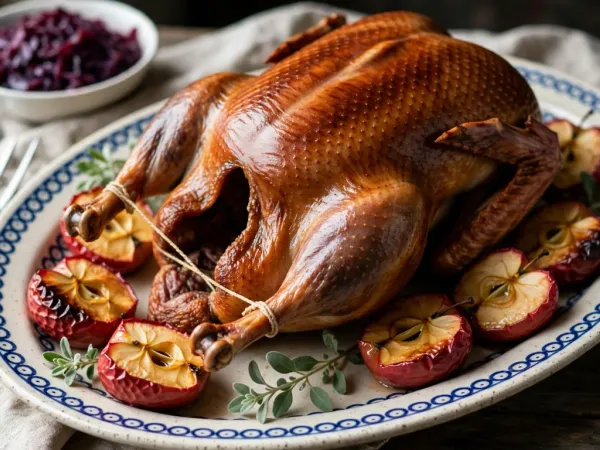
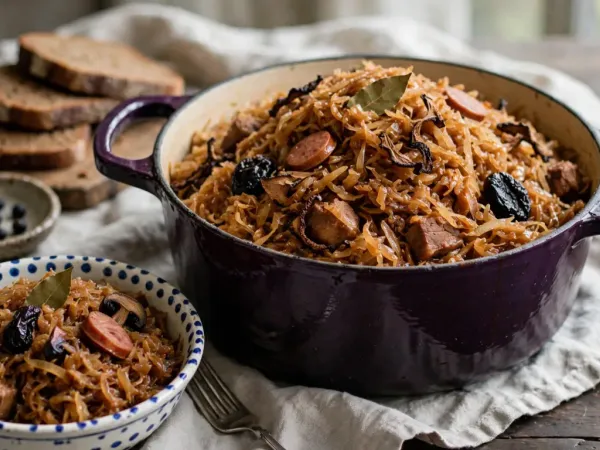
In Poznań, bakeries sell rogale one at a time, by weight, and people eat them with coffee or tea. For a whole St. Martin’s Day menu, serve them after a Polish roast goose, the bird of the same feast. A bowl of bigos the next day uses up the cold weekend.
Keeping them
Eat them within 2 days, wrapped, at cool room temperature, or keep them in the fridge if your kitchen is warm. For longer, freeze them before icing. Thaw them at room temperature, warm them briefly in the oven and ice them then.
Safety, allergens and nutrition
Poppy seed, washed and cooked
Poppy seeds can carry traces of opium alkaloids from the plant. The EU caps them at 20 mg per kg in poppy seed sold to shoppers and 1.5 mg per kg in poppy bakery goods, under Regulation 2023/915. Washing, heating and grinding can cut the levels by 25 to 100%, says the European Food Safety Authority. This recipe does all three.
Buy food-grade poppy seed from a baking supplier, and never brew the seeds into a drink. The US Drug Enforcement Administration warns that “unprocessed or unwashed poppy seeds can contain dangerous amounts of opium alkaloids”. It adds that eating poppy seed products can sometimes cause a positive drug test. If you face one, skip the croissant beforehand. Germany’s risk agency, the BfR, advises against eating large amounts of poppy seed foods in pregnancy.
Raw egg and raw dough
The egg in the filling cooks only in the oven. So bake the croissants until deep gold, and check one: the USDA wants dishes with eggs at 160°F (71°C). Don’t taste the filling once the egg is in, and keep children from nibbling raw dough. The FDA points out that flour is a raw food too.
Allergens
These croissants contain wheat, milk, egg and tree nuts (almonds and walnuts). The crumbs may add more of the same. For a nut-free version, leave out the nuts and the almond extract, and finish the icing with candied orange peel.
Nutrition
One croissant has about 770 calories. It has about 17 g of protein, 41 g of fat (15 g saturated), 87 g of carbohydrate and 9 g of fiber. These are our sums from USDA FoodData Central values for each ingredient, with ordinary poppy seed standing in for white.
Fixes for common problems
- The butter broke through: the dough got warm. Patch the hole with flour, chill it for 20 minutes and carry on.
- The filling leaked: it was too wet or reached the tip. Drain the poppy harder and keep the filling to the wide end.
- The croissants are pale: bake them longer. Color means a cooked center.
- The icing slid off: it was too thin, or the croissants were very hot. Thicken it with more sugar and wait 5 minutes.
- No layers: the butter melted into the dough. Use colder butter and chill longer between folds.
Substitutes for missing ingredients
- White poppy seeds: blue poppy seeds, prepared the same way. The filling will be dark gray.
- Ready-made filling: Polish shops sell ready-made white poppy seed filling. Stir in the nuts, raisins and peel, and skip the cooking.
- Sponge crumbs: ground ladyfingers, plain biscuits or dry breadcrumbs.
- Fresh yeast: 1 teaspoon (3 g) instant yeast, mixed straight into the flour.
- Candied orange peel: chopped dried apricots or a little grated orange zest.
Frequently asked questions
What does rogal świętomarciński mean?
“St. Martin’s croissant”. Rogal is a crescent roll, and świętomarciński means “of St. Martin”.
How do you pronounce it?
Roughly “ROH-gahl shvyen-toh-mar-CHEEN-skee”.
Can I sell my croissants under the name?
Only if you bake in the protected area around Poznań and pass the inspection. At home, call them St. Martin’s croissants.
Why is the filling white poppy seed?
Bakers switched from almond paste to white poppy seed after the Second World War, when almonds were hard to find.
Can I use puff pastry?
You can, but none of the 25 recipes we read does. Puff pastry is crisper and has no yeast, so it bakes thinner and drier.
How big is a real one?
The EU rules set 150 to 250 g. Ours weigh about 200 g before baking.
Tags: white poppy seedalmondsSt. Martin's Daybakingvegetarian