The Sunday Potthesundaypot.com/recipes/pan-de-muerto/
Pan de Muerto: Mexico's Day of the Dead Sweet Bread
By The Sunday Pot Kitchen Updated
- • Two 8-inch (20 cm) loaves take 4 cups (480 g) of bread flour, 3 eggs and a yolk, and 10 tablespoons (140 g) of butter
- • Start with a 20-minute sponge of milk, yeast and flour, and add the butter only after 10 minutes of kneading
- • Keep the dough soft and a little sticky: chill it for 4 hours or overnight instead of adding flour
- • Set aside a quarter of the dough, about 9½ oz (270 g), for the bones and skulls
- • Bake at 350°F (175°C) for 35 to 40 minutes, to 190°F (88°C) in the center
- • Brush with butter and sugar one section at a time while the loaves are warm
Ingredients
2 loaves, 16 servingsInstructions
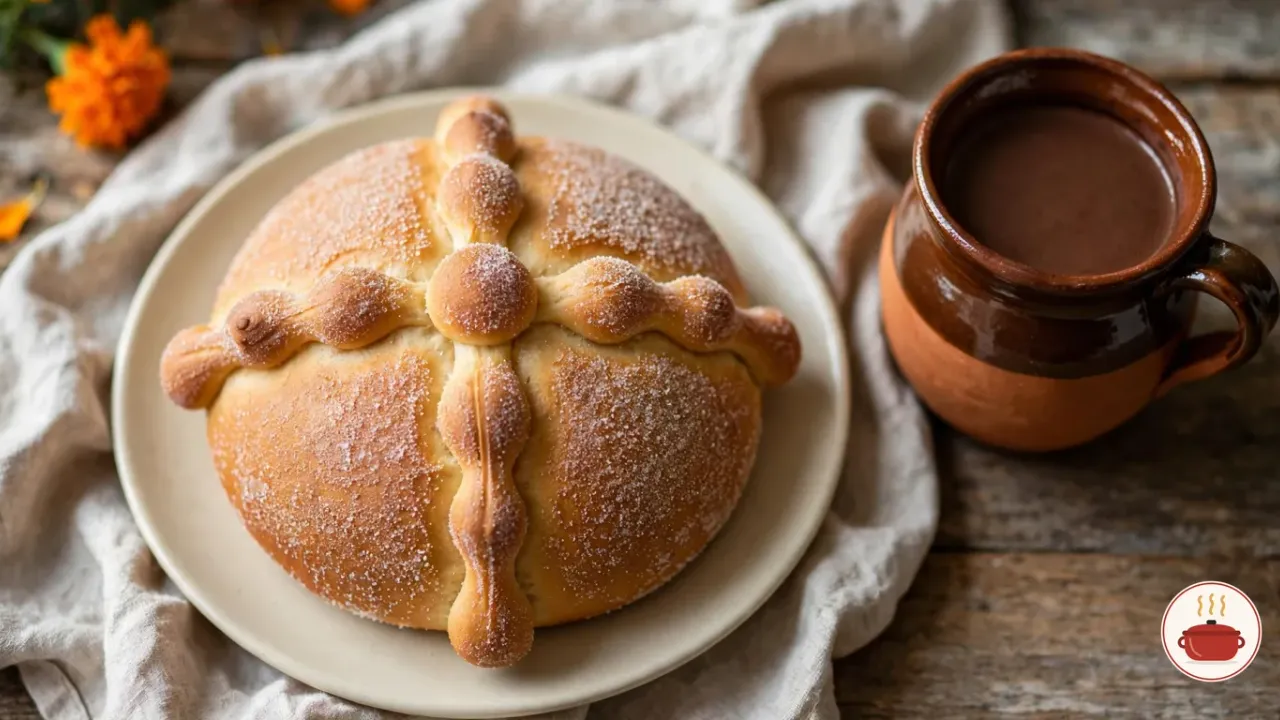
Pan de muerto is the sweet bread of Mexico’s Day of the Dead: a soft, buttery loaf scented with orange blossom, crossed with dough bones and rolled in sugar. This recipe makes 2 loaves of 8 inches (20 cm), with about 45 minutes of hands-on work and a slow rise.
What pan de muerto is
Pan de muerto means bread of the dead. It is an enriched yeast bread, close to brioche, flavored with orange blossom water and orange zest, sometimes with anise. A small ball sits on top, with dough bones running down the sides.
A bread for the altar
For the Day of the Dead, on 1 and 2 November, families set an ofrenda. It is an altar with marigolds, candles, photos and the favorite foods of their dead. “You will not see a home or an altar without Day of the Dead bread,” the Mexican-born cook Pati Jinich told NPR in 2013.
Bakeries sell it from late August into November, but most of it is eaten in the last days of October and the first of November. So notes Mexico’s public employees’ health service, ISSSTE.
What the shapes mean
In Mexico City, the loaf is round, to suggest that life and death go on in a circle. The small ball on top is the skull, and the strips down its sides are bones, or tears. So explains the anthropologist Sarah Bak-Geller of UNAM, Mexico’s national university, to UNAM Global.
Mexico’s agriculture ministry adds that 4 bones can stand for the 4 cardinal directions. The scent of orange blossom is said to stand for the essence of the dead, ISSSTE notes.
A story with no source
You may read that the bread replaced a sacrificed maiden’s heart, dipped in amaranth. Many websites repeat it, some of them official. Yet many stories are told about pan de muerto, and we cannot know if they are true, Bak-Geller says. The bread has, rather, a Christian-European origin, in her view.
Wheat bread came to Mexico with the Spanish, writes David Lorente Fernández of INAH, Mexico’s national anthropology institute. In Europe, bakers made breads for feast days, including bread for the dead. In Mexico, wheat bread may have replaced the ritual amaranth of Aztec times, he adds in the UNAM journal Estudios de Cultura Náhuatl.
That amaranth is well documented. The friars Diego Durán and Bernardino de Sahagún described figures of a god and large bones, shaped from amaranth and maguey honey, notes Ciencia UNAM. Yet the first printed recipe for pan de muerto dates only from 1938, in Josefina Velázquez de León’s Repostería Selecta. A 1951 painting by Gustavo Montoya is the first to show a loaf close to today’s.
Hojaldra, pan de yema and pink sugar
The round, sugared loaf is the classic of Mexico City and the State of Mexico, where some call it hojaldra. So notes INPI, Mexico’s institute for Indigenous peoples. Some towns dust it with pink sugar, after the ceremonial red of pre-Hispanic times. In Oaxaca, bakers make pan de yema, an egg-yolk bread with a small painted sugar face of the dead.
In Puebla, one version is brushed with egg, covered in sesame seeds and flavored with anise instead of orange blossom, as Matador Network describes it.
Why pan de muerto is in season now
In 2026, the Day of the Dead falls on Sunday 1 and Monday 2 November. Mexico City holds its big parade on Saturday 31 October, by the city’s tourism office. It is the parade’s tenth year, La Silla Rota notes.
The bread arrives earlier every year. The season used to last a week or two, but some shops now stock it 2 or 3 months ahead. Genaro Ruiz Manríquez, vice-president of the bakers’ chamber CANAINPPA, said so to Changoonga in September 2026.
By 19 September, Walmart Mexico sold a small loaf for 20 pesos and Soriana one for 21.90, Gastrolab found. On 6 October, the bakery chain El Globo began selling filled family loaves with a collectible porcelain figure, for 299 to 359 pesos, La Crónica reported.
Bakers are playing with it too. On 3 and 4 October, about a dozen bakers and food makers filled the Museo Kaluz in Mexico City for the sixth Festival de Pan de Muerto. A 190-peso ticket included a class in shaping the bread, adn40 reported. Flavors ran to lavender, guava, cacao, hoja santa and squash, Récord found on site.
North of the border, Mexican bakeries draw crowds. In the year to August 2025, Yelp searches for “panadería Mexican” rose 1,184%, and searches for conchas 235%, by the company’s 2026 trend report. We found no sales or search figure for pan de muerto itself outside Mexico. The pull is the calendar.
What you need for pan de muerto
Bread flour
Bread flour holds the shape of a free-standing loaf, bones and all. In a test by King Arthur Baking, its bread flour, at 12.7% protein, made a stiffer dough that rose up rather than out. The Mexican cook Maricruz Avalos asks for a flour of at least 11% protein. In the UK, use strong white bread flour.
Butter and eggs
They make the crumb soft and rich. Use unsalted butter, soft enough to press with a finger, and eggs at room temperature, so the dough stays warm and rises well.
Orange blossom water
It is distilled from orange blossoms, and it gives the bread its scent. Strength varies by brand: a common Lebanese brand, Cortas, is 65% orange blossom water and 35% water. A concentrated extract, sold as esencia in Mexico, is much stronger, so use only 1 teaspoon of it.
Look for it at a Middle Eastern grocer. Even in Mexico, the newspaper Excélsior sends readers to Lebanese shops.
Orange and anise
Zest and juice of a fresh orange add a brighter citrus note. Anise seed is optional: 3 of the 12 recipes we compared use it.
How to make pan de muerto that keeps its bones
We compared 12 recipes, 9 of them by Mexican or Mexican-American cooks and bakers, or published in Mexico. They agree on the method, if not on the butter.
Start with a sponge
Eight of the 12 begin with a sponge of liquid, yeast and some of the flour. In Pati Jinich’s recipe for King Arthur Baking, it rests 20 to 25 minutes, until bubbly.
Add the butter after the gluten
Six of them add the butter only after a long knead, once the gluten has formed. King Arthur adds it 3 tablespoons at a time, then kneads 8 to 10 minutes more. Butter added too early coats the flour and slows the gluten.
How rich to make it
By weight of flour, the recipes use a median of 22% fat, 34% egg and 22% sugar. The richest, brioche-style ones use 40 to 50% butter, and one uses none. This recipe uses 29% butter, 35% egg and 22% sugar.
Keep the dough soft
The dough should be soft and a little sticky. “Resist the urge to add more flour,” King Arthur warns. Chilling it for 4 hours or overnight firms the butter, and makes it easy to shape.
Make the bones stiffer
Most recipes keep a quarter or a fifth of the dough for the decorations. Loaves get 2 to 4 bones, and all 12 recipes put a ball on top. Guadalupana Bakery in Brooklyn kneads extra fat, sugar and flour into the bone dough to stiffen it, in its recipe for NYT Cooking. Maricruz Avalos just dusts the small pieces with flour, so they keep their shape.
Bake at 350°F to 190°F inside
Ten of the 12 recipes bake at 325 to 360°F (163 to 182°C). Hotter ovens gave a dark crust and dry edges, so Rick Martínez bakes at 325°F, he wrote in Bon Appétit. Three recipes bake to 190°F (88°C) in the center. That is a baker’s test of doneness, and foil over the top after 20 minutes keeps the crust from getting too dark.
Sugar it while it is warm
Nine recipes brush the baked bread with melted butter, then cover it in sugar. Work one section at a time, so the sugar sticks before the butter sets.
Variations: sesame, pink sugar, small buns
With sesame, Puebla style
Skip the butter and sugar topping. Before baking, brush the loaves with 1 beaten egg and sprinkle them with 2 tablespoons of sesame seeds. Use the anise seed in the dough, and leave out the orange blossom water.
Pink sugar
Rub ⅓ cup (65 g) of sugar with 1 drop of red food coloring until evenly pink, and use it for the topping.
Small buns
Shape 10 buns instead of 2 loaves, each about 3½ oz (100 g) with 2 small bones and a ball. Bake them for 15 to 20 minutes.
Filled with cream
Mexico City bakeries sell loaves filled with nata, a thick cream. Split a cooled loaf across the middle and fill it with 1 cup (240 ml) of cream, whipped with 2 tablespoons of sugar. Keep it in the fridge and eat it the same day.
With lard
Guadalupana Bakery makes its dough with lard instead of butter. Use the same weight, 5 oz (140 g).
Serving and storing pan de muerto
Serve pan de muerto at room temperature, in wedges, with a cup of hot chocolate or coffee. In central Mexico, atole and champurrado go with it on the altar and the table, notes the news site Ruptura 360. For another sweet made for a festival this season, try gajar ka halwa, cooked for Diwali. For a warm British pudding, there is sticky toffee pudding.
Keeping it
Kept well wrapped at room temperature, the bread stays soft for 4 to 5 days. To freeze it, wrap each loaf in plastic and freeze it for up to 2 to 3 months, as Maricruz Avalos does. If you see mold on it, throw the whole loaf away: mold reaches below the surface of bread, the USDA warns.
Make it ahead
The dough keeps in the fridge overnight. Because it holds raw eggs, bake it within 24 hours, as the USDA advises for dishes made with raw eggs.
Do not taste the raw dough
Raw flour and raw eggs can carry germs, the CDC warns. It also advises against letting children play with raw dough, so keep small helpers for the sugaring.
Calories and protein
One serving, an eighth of a loaf, has about 270 calories, 6 g of protein and 13 g of fat. It has about 33 g of carbohydrate, 1 g of fiber and 165 mg of sodium. These are estimates from USDA figures.
Allergens
The bread holds wheat, eggs and milk, three of the major food allergens the FDA lists. The sesame version adds sesame.
Fixes for bones that slide, flatten or burn
- The bones slide off: brush the loaf with water first, and press the ball down firmly to anchor the bones.
- The bones lose their knobs: the decoration dough was too soft. Dust it with flour, and make the knobs deeper.
- The dough is too sticky to shape: chill it for an hour. If it stays sticky, add 1 or 2 tablespoons of flour, and check that your flour has at least 11% protein.
- The bread is dense: it rose in a cold room. Give it more time in a warm, draft-free spot, such as an oven that is off with its light on.
- The top browns too fast: cover it with foil after 20 minutes, and check your oven’s temperature.
- The sugar will not stick: the bread cooled. Brush it with 2 tablespoons of orange jam or simple syrup, and sprinkle again, as Hot Bread Kitchen suggests.
Substitutes for missing ingredients
- Orange blossom water: the zest of 1 more orange, or 1 tablespoon of rose water, which Pati Jinich also allows.
- Bread flour: all-purpose flour, with 1 tablespoon less orange juice. The loaves will spread a little more.
- Instant yeast: the same weight of active dry yeast, stirred into the warm milk.
- Fresh orange juice: whole milk.
- Butter in the dough: lard, by the same weight.
- Anise seed: leave it out.
Frequently asked questions
What does pan de muerto mean?
It means bread of the dead. It is baked for the Day of the Dead, on 1 and 2 November.
What do the bones on pan de muerto mean?
The ball on top is a skull, and the strips are bones or tears. Some say the 4 bones stand for the 4 cardinal directions, and the round loaf for the cycle of life and death.
What does pan de muerto taste like?
It tastes like a soft, buttery brioche, scented with orange blossom and orange, with a crunchy coat of sugar.
Is the human sacrifice story true?
No source supports it. Historians trace the bread to Spanish wheat and European breads for the dead, perhaps with echoes of Aztec amaranth figures.
When do Mexicans eat pan de muerto?
From late August to early November, and above all from late October to 2 November.
Can I make pan de muerto ahead?
Yes. Chill the dough overnight and bake it the next day, within 24 hours. The baked bread keeps 4 to 5 days, wrapped.
Why did the bones fall off my pan de muerto?
The loaf was not wet enough to hold them, or the ball was not pressed down. Brush the dough with water, and press the ball firmly into the center.
What do you drink with pan de muerto?
Hot chocolate, champurrado or coffee.