The Sunday Potthesundaypot.com/recipes/hotteok/
Hotteok: Korean Sweet Pancakes with Brown Sugar Filling
By The Sunday Pot Kitchen Updated
- • Make a wet, sticky yeast dough: about 80 g of water for every 100 g of flour
- • Swap a fifth of the wheat flour for glutinous rice flour for a softer, chewier bite
- • Fill each 70 g piece with about 1½ tablespoons of brown sugar, cinnamon and finely chopped nuts
- • Fry seam side down first, then flip and press to about 4 inches (10 cm) across
- • Keep the heat medium-low so the sugar turns to syrup before the crust burns
Ingredients
8 hotteokInstructions
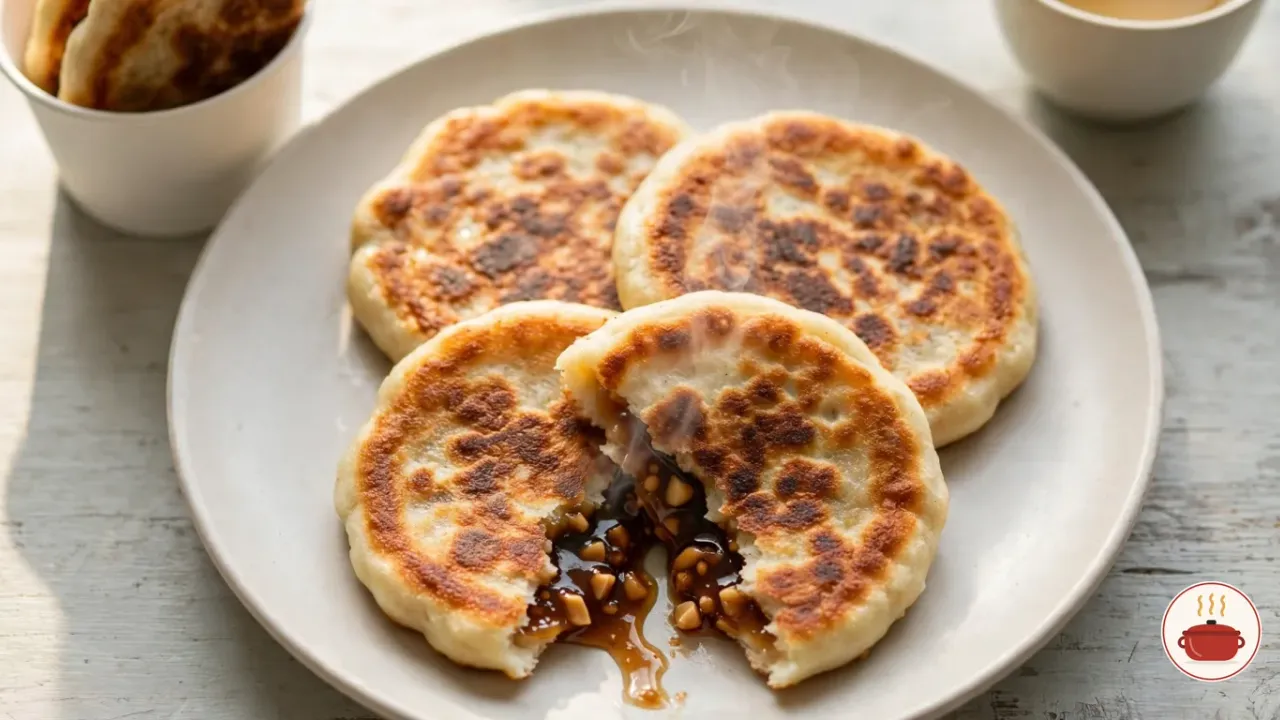
Hotteok (호떡) are Korean pan-fried pancakes with a pocket of hot brown sugar syrup inside. A soft yeast dough, part glutinous rice flour, is wrapped around brown sugar, cinnamon and chopped peanuts, then fried and pressed flat. This recipe makes 8 in about 2¼ hours.
What hotteok is
The syrup is inside
Each pancake is a flat disc about 4 inches (10 cm) wide and ½ inch (1.3 cm) thick. The outside is crisp and chewy. Inside, the sugar melts into a syrup that runs when you tear it. The Korean recipe blog Korean Bapsang describes “a golden fried dough filled with a gooey brown sugar syrup and nuts”. It pictures one bought from a street cart “on a cold winter day”.
Nothing is poured over it. There is no butter, no maple syrup and no stack. A street vendor presses each one thin, fries it in plenty of oil, folds it in half and hands it over in a paper cup. That is how a 2024 column in the magazine Lady Kyunghyang remembers the stalls of the writer’s childhood.
Why some of the flour is rice
More than half the home recipes we read mix wheat flour with some glutinous rice flour (chapssal-garu). You can make the dough with all-purpose or bread flour alone, Korean Bapsang says, but “the sweet rice powder makes hotteok soft and chewy”. Boxed “glutinous rice” mixes hold very little. In a 2017 comparison by the newspaper JoongAng Ilbo, CJ’s had 3.7% and Ottogi’s 5%.
Where hotteok comes from
A “foreign” cake
The ho in the name is the character 胡, an old word for foreigners that the Encyclopedia of Korean Culture glosses as “barbarian”. The Standard Korean Dictionary defines hotteok as a round, flat cake of wheat or glutinous rice flour, filled with sugar and fried in oil. “It came from China,” the entry adds. You may read that ho is the sound of blowing on hot food. No dictionary we read supports that story.
Chinese shops after 1882
The Encyclopedia of Korean Culture dates hotteok’s arrival to the 1882 trade treaty between Joseon Korea and Qing China, which brought Chinese migrants. By 1889 a hotteok shop run by a Cantonese migrant was trading in Seoul. There were 17 such shops in 1906 and 203 in 1923, the encyclopedia says, and 1,139 across the country by October 1930.
Those shops called the brown sugar version tanghuoshao, a “sugar fire-baked” bun, and baked it in clay ovens. In the Chinese-speaking world, the Korean style is now called “brown sugar cake” (黑糖餠), the same entry notes.
In the 1920s newspapers
Hotteok shows up often in the colonial-era press. On March 15, 1921, the Dong-A Ilbo reported a theft of flour and cash from a hotteok seller’s house. In January 1926, the Sidae Ilbo counted more than 100 hotteok sellers among some 900 Chinese residents of one Seoul police district.
Not everyone approved. In 1922, a writer in the magazine Gaebyeok urged readers to skip udon and hotteok shops for lunch. Eat Korean seolleongtang or rice soup instead, the writer argued.
The riots of 1927 and 1931
Chinese-run hotteok shops suffered the worst damage in the anti-Chinese riots of 1927 and 1931, the encyclopedia says. In July 1931, false press reports of a clash in Manchuria set off attacks across Korea. Colonial officials counted 119 Chinese killed, the Kyeongin Ilbo recalled in 2022.
A writer signing as Geumdong looked back on the Pyongyang riot in Gaebyeok in 1934. A police inspector told the writer that not even the tiny hotteok stalls “tucked in every corner” had been left unsmashed.
From the oven to the frying pan
Koreans took up the trade too. The family behind Jungdong Hotteok in Gunsan says a grandfather had worked in a Chinese shop. He began selling hotteok after Korea’s liberation in 1945, the family told the Jeonbuk Domin Ilbo in 2013.
The fried street version came later. It “debuted in 1970 with the introduction of cooking oil to the mass market”, says KOREA, a magazine of Korea’s culture ministry. We found no older source for that date. Chinese hotteok shops faded from the 1970s, the encyclopedia says, though a few carry on, such as Bokraechun in Incheon’s Chinatown.
Busan’s seed hotteok
In Busan, ssiat hotteok is fried, cut open and stuffed with sunflower seeds, pumpkin seeds and peanuts. It is said to have started on the streets of Nampo-dong in the 1980s, the encyclopedia’s Busan entry says, hedging its own date. A story that Korean War refugees invented it is often told, but we found no record behind it. In a 2020 survey on the city’s tourism site, Visit Busan, foreign travellers ranked it Busan’s second-best food, after pork and rice soup. In 2012 the Daegu paper Maeil Shinmun noted its nickname, “Lee Seung-gi hotteok”, after the singer ate one on TV.
Why hotteok costs ₩2,000 this winter
One pancake, double the price
On November 6, the Seoul daily Asia Economy found a hotteok shop in Gwanghwamun charging ₩2,000 a pancake, up from ₩1,000. It blamed the weak won, which makes imported wheat, sugar and butter dearer. The same shop turned up again in two other papers by November 15, so treat it as one example, not a survey.
In January, every hotteok stall at Moraenae Market in Incheon charged ₩2,000. The Kyeongin Ilbo added up national price data: between December 2020 and December 2025, flour rose about 38%, cooking oil 56% and sugar 47%. Its headline played on an old saying. “Like a fire at a hotteok shop” means a noisy crowd, and the paper called it a thing of the past.
The sugar cartel
On February 12, 2026, the Korea Fair Trade Commission fined the country’s three sugar makers ₩408.3 billion. CJ CheilJedang, Samyang and Daehan Sugar had agreed on the timing and size of price changes eight times, from February 2021 to April 2025: six rises and two cuts. That is how the commission’s chair put it in a government briefing.
The three sell about 89% of Korea’s sugar, Seoul Shinmun reported. Prosecutors had charged executives on February 2. By their count, sugar rose as much as 66.7% above pre-cartel prices, the legal daily Lawtimes reported. Those are prices between companies, not shop prices. Reports from July and October give the fine as about ₩396 billion, and we found no explanation for the change.
Flour and syrup too
On May 20, the commission fined seven flour millers ₩671.0 billion, a record at the time, Newsis reported. By September 2022, their all-purpose flour cost 38% to 74% more than in December 2019, depending on the company. The millers were told to reset prices to pre-cartel levels. We found no report of the result.
In July a starch syrup cartel drew ₩747.6 billion more. That took the year’s food-ingredient fines to ₩1.8155 trillion, above the old yearly record of ₩1.333 trillion set in 2017, Newsis said.
An apology in parliament
At the National Assembly’s audit on October 7, CJ CheilJedang’s chief executive apologized “to the public” for damaging fair competition. Samyang’s chief executive said the company was “truly sorry” it had failed to keep the public’s trust, the broadcaster MTN reported.
Both firms also sell hotteok mix. Samyang launched Korea’s first in 2005 and CJ followed in 2006, JoongAng Ilbo noted in its 2017 comparison.
Sugar is dearer worldwide
The FAO Sugar Price Index averaged 121.3 points in October. That is 28.8% above a year earlier and the highest since December 2024, the UN food agency said on November 6. In Korea, consumer prices rose 2.8% in the year to October and processed foods 2.9%, the national statistics office said in its November 3 briefing.
Korea’s price statistics track no figure for hotteok itself. Stall prices are the best guide we found.
Hotteok recipes compared: 32 read in full
We read 32 published recipes, 25 of them in Korean. Most of the Korean ones come from home cooks on the recipe site 10000recipe. The English ones are by Korean or Korean-American authors, and one is from the Korean government. Our counts below cover the 22 that are made from scratch with yeast and pan-fried.
A wet dough on purpose
The middle recipe uses about 78 g of liquid for every 100 g of flour. “Dough should be fully wet and sticky. Wetter than pasta dough,” says Kimchimari’s hotteok recipe. One home cook on 10000recipe makes it a little wetter in winter and stiffer in summer.
Rice flour, water or milk
Thirteen of the 22 add glutinous rice flour, a median of 23% of the flour. The rest use wheat only. Twelve mix the dough with water and 6 with milk. Korean cooks lean to water and English-language recipes to milk.
Yeast and rising
The middle amount of yeast is about 1.5% of the flour. The middle rise is 80 minutes. Several let the dough double in about an hour, knock it back, then rest it 20 to 30 minutes more.
Brown sugar, cinnamon, peanuts
Eighteen use brown sugar, and 18 add cinnamon. Sixteen add nuts, peanuts in 10 and walnuts in 8. “Peanuts are cheaper than walnut so that’s what most street vendors use in Korea,” Kimchimari notes. Three stir a little flour, starch or breadcrumbs into the sugar. Adding flour or ground peanuts keeps the sugar from running out, Maeil Shinmun noted in 2012.
Press after the first flip
Thirteen press the pancake right after the first flip. A spatula is named more often than a hotteok press, 11 to 8. One cook with no press used a potato masher. Anything with a flat bottom works, the cook wrote.
Low heat wins
Eleven ask for low or medium-low heat, against 4 that stay at medium or above. “If the heat is high, only the outside burns, and inside the sugar stays hard,” a 2025 recipe on 10000recipe warns (our translation). It can smell of raw flour too.
Fixes for hotteok that leak, tear or stay raw
- The filling leaks into the pan: the seam was not sealed. Pinch it hard and fry it seam side down first.
- A hole appears when you press: you pressed too hard or too thin. Kimchimari stops at about 4 inches (10 cm) across.
- The dough tears: the nuts were too big. Chop them fine.
- The outside burns but the sugar stays hard or smells of raw flour: the heat is too high. Turn it to low for the last side.
- The pan burns between batches: leaked sugar is catching. Wipe it out, as King Arthur advises.
Variations
- Ssiat hotteok: fry a plain pancake, cut a slit along one side and stuff in sunflower seeds, pumpkin seeds and chopped peanuts mixed with brown sugar.
- Wheat only: use 300 g all-purpose or bread flour. Nine of the 22 recipes do.
- Boxed mix: CJ and Ottogi mixes come with a filling packet and a yeast sachet, and need no separate rise.
- With ice cream: a few Korean recipes and the KOREA magazine top it with a scoop of ice cream.
Serving hotteok
Eat hotteok warm, within a few minutes of frying. For the street-stall effect, fold each one in half and stand it in a paper cup to catch the syrup. Kimchimari pairs it with green tea or cold milk.
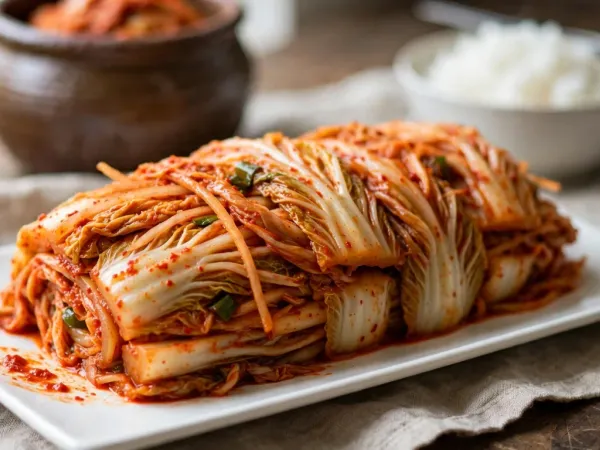
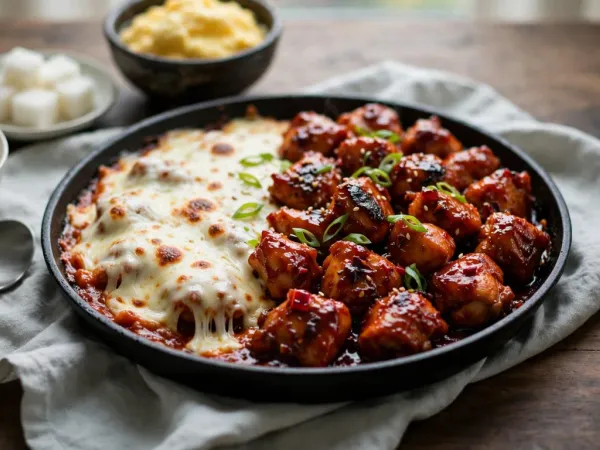
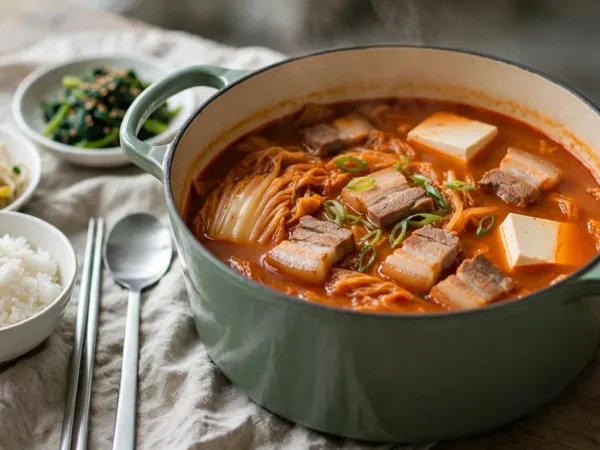
Make it the sweet end of a Korean meal, after kimchi jjigae and a dish of napa cabbage kimchi. For a bigger spread, start with sticky, fiery buldak.
Storing and safety
The syrup is the danger
The filling comes out of the pan far hotter than the dough feels. On cold days, cut hotteok open with chopsticks and let them cool before biting, an emergency doctor advised in Korea Health Log. Melted sugar is sticky and clings to skin, so it can do more harm than other hot liquids, SBS News warned in 2023.
If sugar burns someone, cool the skin under running water at once. Don’t pick off sugar that has stuck to the burn, the NHS says, and skip butter, creams and oils. Take care when offering hotteok to young children, Beyond Kimchee warns, and let it cool first.
Hot oil
The pancakes fry in a fair amount of oil, so stay at the stove. If you must leave the kitchen, switch off the burner, the US Fire Administration advises. Keep a lid close by to smother the pan if the oil catches fire.
Raw dough
Milling grain into flour does not kill harmful bacteria, the FDA notes, so don’t taste the dough. The agency also advises against letting children eat or play with raw dough. Wash your hands after shaping.
Allergens
This recipe contains wheat and peanuts. Walnuts add a tree nut, milk adds dairy, and seed versions often add sesame. US labels have named sesame as a major allergen since January 2023, the FDA’s allergy page notes. In August 2026, Korea’s food safety ministry proposed adding sesame, perilla seeds, almonds and cashews to its labelling list.
Leftovers
Chill leftovers within two hours of frying. The USDA gives cooked leftovers three to four days in the fridge, or three to four months frozen. Reheat them to 165°F (74°C). The sugar melts again and gets just as hot.
Nutrition
One hotteok comes to about 278 calories, with 5 g protein, 9 g fat, 44.5 g carbohydrate, 1.7 g fiber and 151 mg sodium. These are our own sums from USDA FoodData Central values, for the water version. We guessed each pancake soaks up 5 g of frying oil, because we found no measured figure. With milk, it is about 296 calories.
Substitutes
- Glutinous rice flour: more all-purpose or bread flour. The pancakes will be less chewy.
- Dark brown sugar: light brown sugar. Six of the 22 recipes use a light or unrefined sugar.
- Peanuts: walnuts, or sunflower and pumpkin seeds.
- Hotteok press: a wide metal spatula or a potato masher, oiled.
- Milk: water, which most Korean recipes use.
Frequently asked questions
What does hotteok mean?
Ho (胡) is an old word for foreigners, and tteok means a cake, often of rice. The Standard Korean Dictionary says the dish came from China.
Is hotteok Korean or Chinese?
Both. Chinese migrants brought a baked brown sugar bun after 1882. The fried street pancake sold today is a Korean adaptation, the Encyclopedia of Korean Culture says.
Can I make hotteok without rice flour?
Yes. Nine of the 22 recipes we counted use wheat flour only. The rice flour makes them softer and chewier.
Why did my hotteok burst?
The seam was weak or you pressed too hard. Seal each ball firmly, fry it seam side down and press slowly after the first flip.
Can I freeze hotteok?
Yes. Cooked hotteok count as leftovers, which the USDA says keep 3 to 4 months frozen. Reheat them until hot through, and take care: the sugar turns to hot syrup again.
Why is hotteok so hot inside?
The sugar melts into syrup, and the inside stays hotter than the outside feels. Wait a minute or two and cut it open before you bite.
Tags: street foodpancakesbrown sugarpeanutsyeast doughwintersnackpan-fried